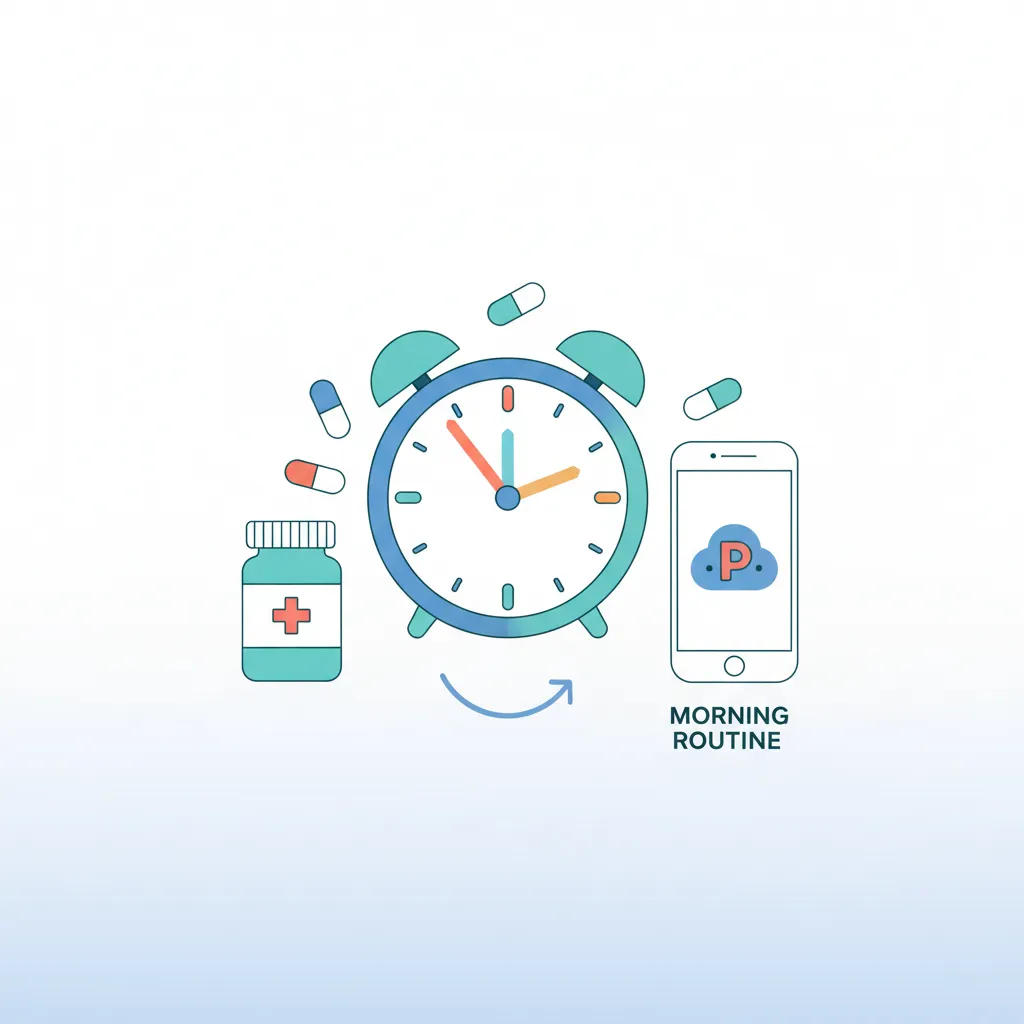
For most morning medications, "morning" means when you wake up, not a fixed hour on the clock. Researchers in the Journal of Biological Rhythms note that the body's circadian clock affects how medications work, which is why consistent timing relative to your own daily routine matters. Some drugs need stricter timing than others, though, so it pays to know where yours falls on the flexibility scale.
Why irregular wake times make medication harder
Not everyone rolls out of bed at 7 AM sharp. Maybe you work from home and sleep in on slow days. Maybe your toddler decides 5:15 AM is morning on Monday but sleeps until 8 on Wednesday. Maybe depression or insomnia makes your wake-up time a moving target.
Whatever the reason, irregular wake times are common. And they directly affect how well people stick to their medication schedules. A 2022 study in Scientific Reports analyzing over 11,000 person-years of health data found that shift workers had significantly worse medication adherence than those on fixed daytime routines. A key driver? Forgetting.
That tracks with broader adherence data: timing adherence (taking medication within a specific time window) is the hardest dimension of adherence to maintain, even for once-daily medications. When your wake-up time shifts by two or three hours from one day to the next, a "consistent morning routine" can feel impossible.
Most morning medications are more flexible than you think. The key is knowing which category your medication falls into.
Which morning medications are flexible (and which aren't)
Not all "take in the morning" instructions carry the same weight. Some medications need precise timing. Others just need to land somewhere in your morning routine, whenever that happens.
| Medication Type | Timing Rule | Flexibility | What Actually Matters |
|---|---|---|---|
| Thyroid medication (levothyroxine) | Upon waking, empty stomach | Moderate | Consistency day-to-day and 30-60 min before food matter more than the exact clock time. Read more about levothyroxine timing. |
| Blood pressure meds (ACE inhibitors, ARBs, CCBs) | Once daily, same time | High | Most are 24-hour duration, so a 1-2 hour shift rarely matters. Diuretics specifically should stay in the morning to avoid nighttime bathroom trips. |
| Metformin | With meals, same time daily | High | Timing relative to food matters more than the clock. Take it with your first real meal. Learn more about metformin timing. |
| PPIs (omeprazole, pantoprazole) | 30-60 min before first meal | Low-Moderate | "Before first meal" is the real rule, not "before 8 AM." A 1992 study found morning dosing produced better acid suppression than evening, so stick with the morning. More on omeprazole timing. |
| Progestin-only birth control | Same 3-hour window daily | Very Low | Clock time matters here. Traditional POPs (norethindrone) require a strict 3-hour window; newer formulations may allow more flexibility. Check your specific pill's label. (ACOG) |
Cleveland Clinic puts it plainly for blood pressure medications: "For most patients with hypertension, the act of taking the medication as directed has more significance than the timing."
And Mayo Clinic agrees with a broader statement: "As long as the medication is taken regularly, preferably at the same time daily, it doesn't matter what the clock reads."
Bottom line: If your medication has "high" or "moderate" flexibility in the table above, anchoring it to your wake-up routine is a solid approach. If it has "low" or "very low" flexibility, talk to your doctor or pharmacist about whether your varying schedule needs a workaround.
5 strategies for staying consistent with an irregular schedule
1. Anchor to "wake up + 15 minutes," not to 7 AM
Instead of setting a rigid clock alarm, make your medication part of the first 15 minutes after you open your eyes. Feet on the floor, pill in hand. This works because research shows morning doses show higher adherence rates than evening doses.
If you take multiple medications, keep them together in one spot near where you start your morning (nightstand, bathroom counter, kitchen table) so the routine stays the same even when the clock doesn't.
2. Set a "wake window" instead of a single alarm
If your wake-up time typically falls between, say, 6:30 AM and 9 AM, set your medication reminder for the earliest time you might wake up. That way, even on your latest mornings, you're only two and a half hours off, which is well within the flexibility window for most once-daily meds.
If you find yourself wondering how late you can push a morning dose, the answer depends on the medication. For most blood pressure drugs and metformin, a couple of hours late is not a problem. For levothyroxine, the bigger concern is the empty-stomach rule, not the exact hour.
3. Use meal anchoring for food-dependent medications
Some medications are tied to meals rather than the clock. Metformin, for example, should go with food to reduce stomach issues. Omeprazole needs to come 30-60 minutes before your first meal. If your breakfast time shifts, these medications can shift right along with it.
This is actually an advantage for people with irregular schedules: your first meal is a reliable anchor point even when your wake-up time is not. Pair the pill with the meal, and the timing largely takes care of itself. If you have questions about taking meds with food, we have a full guide on that.
4. Keep a "medication travel kit" on your nightstand
This is less about traveling and more about removing friction. When your morning routine is unpredictable, the fewer steps between waking up and taking your pill, the better. A small pouch or tray with your morning meds, a water bottle, and a quick snack (if needed for food-dependent drugs) keeps everything within arm's reach.
If your schedule changes are more dramatic, like switching between day and night shifts, you may need to formally transition your medication timing rather than just sliding it around within a morning window. That's worth a conversation with your pharmacist.
5. Track your actual timing, not just "taken" or "not taken"
Most people only think in binary: did I take my pill, or didn't I? But timing consistency matters too. Keeping a log of when you actually take each dose can reveal patterns, like whether you're consistently 2 hours late on weekends, or whether certain days are worse than others.
If you keep forgetting your medication on specific days, identifying the pattern is the first step toward fixing it. That's much more useful than a vague feeling that you're "bad at remembering."
What this looks like for different lifestyles
Freelancer or remote worker
Your schedule might shift by 2-3 hours depending on your workload. The "wake up + 15 minutes" approach works well. Keep meds at your nightstand, not in the kitchen. If you occasionally sleep until noon, most once-daily medications will still be effective as long as you keep roughly 24 hours between doses.
Parent of a young child
Your wake-up time is dictated by a tiny human with no respect for schedules. The key: stash your meds where the morning chaos starts. If you always go to the kitchen first to make a bottle, that's your medication spot. Your child's unpredictable wake-up calls may actually work in your favor for morning meds, because at least you're never sleeping through them. For more strategies, check out medication scheduling for busy parents.
Retiree
Without a work schedule driving your mornings, it's easy for wake-up times to drift. You might get up at 6 AM one day and 9 AM the next. For most medications, this is fine. The risk is that without external structure, the drift keeps widening. Pick one anchor activity (morning coffee, the dog's breakfast, the newspaper) and attach your medication to that.
Living with depression or insomnia
When you're dealing with depression or insomnia, "just wake up at the same time every day" is not helpful advice. Sleep disruption is part of the condition. For this group, the meal-anchoring strategy (Step 3) often works better than the wake-up strategy, because even on difficult days, you eventually eat something. A persistent alarm that won't let you forget can also help on low-energy mornings.
Rotating shift worker
If you rotate between day and night shifts, a "morning" medication becomes more complicated. The Smith et al. review specifically notes that shift work misaligns your circadian rhythms, making standard timing advice unreliable. For shift workers, we have a dedicated guide on night shift medication scheduling that covers how to transition your medication timing between rotations.
The one rule that always applies
No matter which medication you take or how chaotic your schedule gets, one principle holds: consistency within your own routine matters more than matching a specific clock time.
A review from The Conversation estimates that for roughly 70% of medications, the interval between doses matters more than the exact hour on the clock. So if you wake up at 7 AM on weekdays and 9:30 AM on weekends, taking your medication at wake-up both days keeps you well within an effective window for most drugs.
The exception is the roughly 30% of medications where clock time does matter (like progestin-only birth control or short-acting medications taken multiple times a day). If you're unsure where your medication falls, your pharmacist can give you a clear answer in under a minute.
How Pillo helps with irregular schedules
When your wake-up time changes daily, a standard phone alarm set for 7 AM every morning misses the point. Pillo's persistent alarm system works differently: it won't stop reminding you until you actually acknowledge your dose. So even if you silence your phone at 7 and don't fully wake up until 9:30, the reminder is still waiting for you.
You can also set up flexible snooze times and adjust them on the fly. If you take multiple medications at different times, Pillo's complex schedule support handles the juggling so you don't have to keep it all in your head.
Download Pillo on Google Play and build a reminder system that works with your actual schedule, not an imaginary one.
Frequently asked questions
Does "take in the morning" mean a specific time?
For most medications, "take in the morning" means when you wake up, not a fixed hour like 7 or 8 AM. A review in the Journal of Biological Rhythms confirms that medication timing should follow your personal sleep-wake cycle. The main exceptions are medications with very narrow timing windows, like progestin-only birth control.
Is it okay to take morning medication 2 hours late?
For most once-daily medications, including blood pressure drugs and metformin, taking your dose 2 hours late is not a significant problem. Mayo Clinic notes that regular daily intake matters more than the exact time. If you want more detail, read our full guide on taking medication 2 hours late.
What if I wake up at noon on weekends?
If you normally take your medication at 7 AM on weekdays, taking it at noon on weekends puts you 5 hours late. For high-flexibility medications like most blood pressure drugs, this is generally fine as a one-off. For lower-flexibility medications like levothyroxine, try to keep the gap closer to 1-2 hours. If noon wake-ups are a regular pattern, consider formally shifting your medication time to a later window that works every day.
Should I set my medication alarm for the earliest or latest I might wake up?
Set it for the earliest time in your typical wake window. If you usually wake between 6:30 and 9 AM, set the alarm for 6:30. On days you sleep later, a persistent reminder app will keep nudging you until you respond. This way you never accidentally sleep through the entire dosing window.
Can I take morning medication at night instead?
For some medications, yes, but not without asking your doctor first. Blood pressure medications, for example, have been studied for both morning and evening dosing, and your doctor may recommend one over the other based on your situation. Levothyroxine also has some evidence for bedtime dosing. But switching from morning to evening is a change you should make deliberately and with medical guidance. Read our guide on how to switch medication times for a step-by-step approach.
This article provides general information about medication management and is not a substitute for professional medical advice. Always consult your doctor or pharmacist before making changes to your medication schedule.