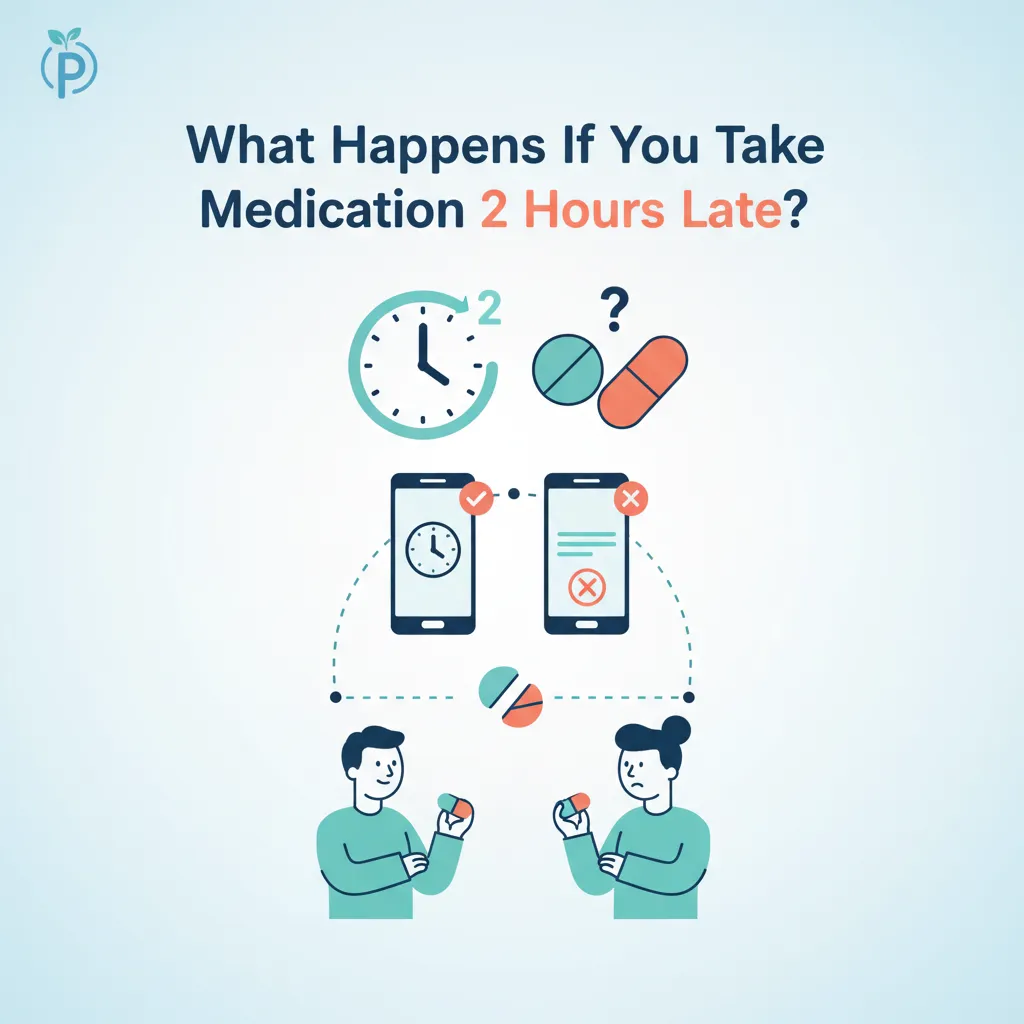
For most once-daily medications, a late medication dose of 2 hours is unlikely to cause problems. But for time-critical drugs like insulin, seizure medications, and Parkinson's drugs, a 2-hour delay can reduce how well your treatment works. It depends on which medication you take and your medication timing window.
Why Medication Timing Gets Confusing
You glanced at the clock and realized you took medicine late by 2 hours. Now you're wondering: Is this a big deal? Should I skip it? Take a double dose?
A study published in AIDS Care found that patients and doctors have very different ideas about what counts as a "missed dose." 55% of patients said a 6-hour delay counted as missed, but only 1 out of 17 clinicians agreed. Over one-third of patients said the right move was to skip a late dose entirely. Only 12% of clinicians agreed with that choice.
The confusion is real. But pharmacists generally consider a window of 1 to 2 hours before or after your scheduled time as acceptable for most non-time-critical medications. Clinical guidelines from the Institute for Safe Medication Practices (ISMP) use this same benchmark in hospital settings, and CMS federal guidelines define time-critical medications as those requiring administration within 30 minutes of schedule. But some medications have much stricter rules.
The Halfway Rule: A Simple Way to Decide
Before looking at specific medications, here is a general rule that pharmacists use. It is called the halfway rule.
If less than halfway to your next dose, take the late dose now. If more than halfway, skip it and take the next one on time. Never double up.
Here is a quick example. Say you take a medication every 8 hours at 8 AM, 4 PM, and midnight. You miss your 4 PM dose and remember at 6 PM. That is only 2 hours late, well under the 4-hour halfway mark. Take it. But if you remember at 9 PM (5 hours late, past the halfway point), skip that dose and take your midnight dose on time.
This rule works well for most medications. But certain drugs need extra caution.
How Late Is Too Late for Medication? It Depends on the Drug
Here is how common medication types break down by timing sensitivity.
| Category | Examples | 2 Hours Late? | Why |
|---|---|---|---|
| Time-Critical | Seizure meds, insulin, Parkinson's drugs | Contact your pharmacist or prescriber | Narrow therapeutic index means small drops in blood levels can cause problems |
| Use Caution | Blood thinners (warfarin, DOACs), progestin-only birth control, some antibiotics, thyroid medication | Take now and watch your schedule closely | Moderate timing sensitivity; still usually OK at 2 hours |
| Likely Fine | Statins, most blood pressure meds, long-acting SSRIs | Take it and resume your regular schedule | Long half-life keeps the drug active in your body for hours or days |
Now let's look at specifics.
Time-Critical Medications
Seizure medications have a narrow therapeutic index, meaning there is a thin line between an effective dose and a dangerous one. A 2023 study in Neurology found that the right approach for a delayed dose of antiseizure medications depends on the specific drug's half-life, how late the dose is, and your dosing interval. Generic advice like "just take it when you remember" is overly simplistic for these drugs. If you take seizure medication and are running late, call your pharmacist for guidance specific to your drug. For more detail, see our guide on missed doses of lamotrigine.
Insulin timing matters because it is tied to meals. For basal (long-acting) insulin, a 2-hour delay is generally manageable. If you are more than a couple of hours late, talk to your care team about whether to adjust the dose. Mealtime insulin taken 2 hours after eating can cause blood sugar to spike first, then drop too low later when the insulin peaks. Always check with your care team about your specific insulin plan.
Parkinson's disease medications are among the most time-sensitive drugs prescribed. The target window is within 30 minutes of your scheduled time. A delay of even 1-2 hours can lead to worsening tremors, stiffness, trouble with balance, and difficulty swallowing.
Use Caution
Blood thinners like warfarin should be taken the same day you remember. Two hours late is fine. If you do not remember until the next day, skip that dose entirely. Never take a double dose. Newer blood thinners (DOACs) like Eliquis and Xarelto follow similar rules, though a 2024 study in Blood Advances showed that individualized remedial dosing strategies work better than generic advice. For specifics, check our guides on missed doses of Eliquis or Xarelto.
Progestin-only birth control (the minipill) has a strict 3-hour window for traditional formulations containing norethindrone or norgestrel. Two hours late is still within that window, but barely. If you go past 3 hours, use backup contraception for 48 hours. Note: if you take a drospirenone-only pill (such as Slynd), the window is 24 hours. Talk to your pharmacist if you are unsure which type you take. Combination pills are much more flexible. A 2-hour delay with a combo pill is not a concern at all. For a deeper dive, see our missed dose of birth control guide.
Thyroid medication (levothyroxine) works best on an empty stomach, typically 30-60 minutes before breakfast. Taking it 2 hours late usually means you have already eaten, which can reduce absorption. If you took medicine late and have already eaten, wait at least 2 hours after your last meal before taking it, then resume your normal schedule the next day. For more, see our guide on the best time to take levothyroxine.
Antibiotics taken on a schedule (like every 8 hours or 3 times a day) should be spaced evenly to keep steady levels in your bloodstream. Two hours late is unlikely to cause treatment failure, but try not to make it a habit. If you have been missing antibiotic doses regularly, check our guide on what to do after a missed antibiotic dose.
Likely Fine
Blood pressure medications with long half-lives are very forgiving. Amlodipine, for example, has a half-life of 30 to 50 hours, meaning the drug stays active in your body for days. A 2-hour delay barely makes a dent. The same goes for lisinopril and losartan. See our guides on the best time to take lisinopril or amlodipine.
Statins like atorvastatin (half-life ~14 hours) and rosuvastatin (half-life ~19 hours) have plenty of wiggle room. A 2-hour delay will not reduce their effectiveness. Shorter-acting statins like simvastatin are a bit more timing-sensitive, but still far more forgiving than time-critical drugs.
Long-acting antidepressants like fluoxetine (Prozac) have a half-life of several days (1-3 days acutely, 4-6 days with chronic use), with its active metabolite lasting even longer. Two hours late is nothing for this medication. Other SSRIs like sertraline (half-life ~26 hours) and escitalopram (half-life ~27-33 hours) handle a 2-hour delay just fine. For more, see our guide on missed doses of antidepressants.
What to Do Right Now If You Took Medicine Late
If you are reading this because you just realized you are 2 hours late, here is your plan:
- Check the table above and find your medication category.
- Apply the halfway rule. If you are less than halfway to your next dose, take the late dose now.
- Do not double up. Never take two doses to make up for a late one. If you are unsure whether you took your dose, check a pill organizer or tracking log before taking another.
- Take your next dose at the normal time to get back on schedule.
- If you are unsure, call your pharmacist. This is especially important for time-critical medications.
If you are chronically running late with your medication, it might be worth talking to your doctor about shifting your schedule to a time that fits your routine better.
How Pillo Can Help You Stay on Time
Most late doses happen because the reminder was easy to ignore. Pillo is a medication reminder app with persistent alarms that will not stop until you acknowledge them. If you tend to sleep through gentle notifications, that is the point.
If you are busy when your alarm goes off, Pillo's smart snooze re-alerts you when you get home or when your phone call ends. You can also track multiple medications with different timing windows.
FAQ
Is 2 hours late too late for blood pressure medication?
For most blood pressure medications, no. Drugs like amlodipine, lisinopril, and losartan have long half-lives, meaning they stay active in your body well beyond a 2-hour window. Take the late dose and resume your normal schedule. If you take a short-acting blood pressure medication multiple times per day, apply the halfway rule.
Can I take my birth control 2 hours late?
If you take a combination pill, a 2-hour delay is not a problem. If you take a progestin-only pill (minipill), 2 hours is still within the 3-hour safety window, so take it right away. But do not let it go past 3 hours, or you will need backup contraception for 48 hours.
Should I double my dose if I'm 2 hours late?
No. Never take a double dose to make up for a late one. Take your regular single dose when you remember, then continue your normal schedule. Doubling up increases the risk of side effects without providing extra benefit.
Which medications are most dangerous to take late?
The most time-sensitive medications include seizure drugs (like phenytoin and carbamazepine), Parkinson's disease medications, insulin, and narrow therapeutic index drugs such as warfarin, lithium, and digoxin. For these, even small delays can cause breakthrough symptoms or dangerous blood level swings. Always talk to your pharmacist about your specific medication.
Does it matter if I take my thyroid medication late?
Yes, timing matters for levothyroxine. It works best on an empty stomach, ideally 30-60 minutes before eating. If you are 2 hours late and have already eaten, wait at least 2 hours after your last meal before taking it. A single late dose will not cause harm, but consistent late dosing can reduce absorption over time. See our full guide on the best time to take levothyroxine.
What if I'm always taking my medication late?
If you are consistently running behind, the problem might be your scheduled time rather than your memory. Talk to your doctor about switching your medication time to one that fits your daily routine better. You can also use a persistent alarm app that will not let the reminder slip by unnoticed.
This article provides general information about medication timing and is not a substitute for professional medical advice. Always consult your doctor or pharmacist before making changes to your medication schedule.
Reviewed under our Medical Review Policy.