Shift workers can anchor doses with the best free medication reminder app for Android.
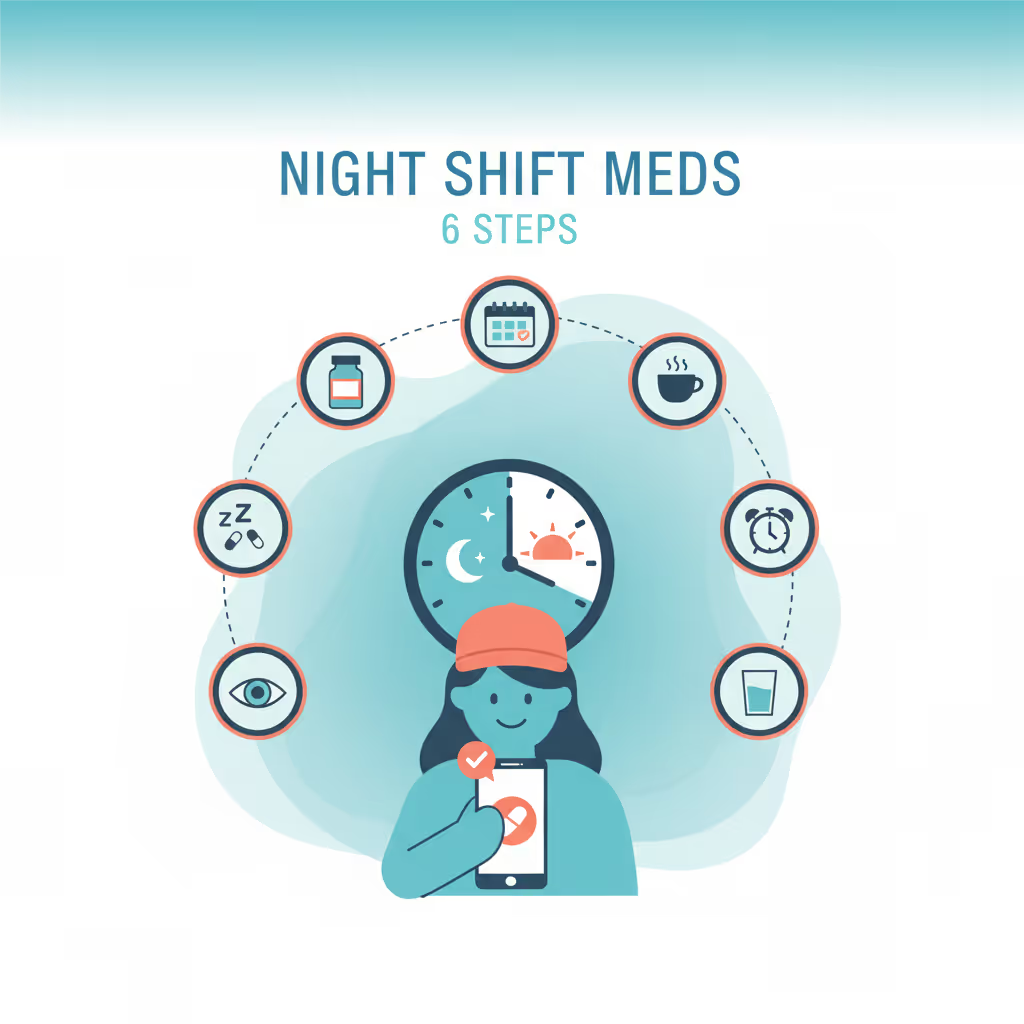
The key to managing medication on night shifts is anchoring your doses to your personal routine — not the clock. Take your "morning" medication when you wake up (even if that's 6 PM) and your "evening" dose before your sleep time. The most important rule: keep the same number of hours between doses every day, and talk to your pharmacist before making any changes.
Why Night Shift Workers Struggle With Medication
If you're juggling a night shift and a pill schedule designed for 9-to-5 life, you're not alone.
About 16% of U.S. workers work non-daytime schedules. And here's the tough part: roughly half of Americans don't take their medications as prescribed, and for shift workers, the odds are even worse. Irregular schedules are one of the biggest reasons people miss doses.
Your medication labels probably say things like "take with breakfast" or "take at bedtime." But when breakfast is at 5 PM and bedtime is 8 AM, those instructions stop making sense.
The challenge isn't laziness or forgetfulness. It's that standard medication instructions weren't designed for a life where "morning" means late afternoon. Starting night shifts often means you need to learn how to safely switch your medication times to match your new routine. Add rotating shifts to the mix, and your routine changes every few days.
The good news: with a few smart adjustments, you can take your medication consistently — without losing sleep over it.
How to Build a Night Shift Medication Schedule That Works
Step 1: Redefine "Morning" and "Night" Around Your Sleep
Forget what the clock says. Your medication schedule should follow your personal sleep-wake cycle:
- "Morning" medication → Take when you wake up, even if it's 4 PM or 6 PM
- "Bedtime" medication → Take before your sleep period, even if it's 7 AM
- "With meals" medication → Take with whatever meal you're eating, regardless of the hour. Night shifts often mean irregular eating patterns — see our guide on when to take medication with food for specific rules by drug type
The key principle: match your doses to your daily rhythm, not the sun.
Step 2: Keep the Same Hours Between Doses
Consistency matters more than the specific clock time. If you take a medication every 12 hours, keep that 12-hour gap steady.
Example for a 7 PM – 7 AM shift:
- Dose 1: 5:30 PM (when you wake up, before your shift)
- Dose 2: 5:30 AM (before you wind down to sleep)
Example for once-daily medication:
- Pick one anchor point in your routine that never moves — like right after waking up or right before brushing your teeth
- Stick with that same anchor every single day
Example Medication Schedules by Shift Pattern
| Shift Pattern | Wake Up | "Morning" Dose | "Evening" Dose | Sleep |
|---|---|---|---|---|
| Fixed nights (7 PM–7 AM) | 5:00 PM | 5:30 PM | 5:30 AM | 8:00 AM |
| Rotating 3-shift (nights week) | 5:00 PM | 5:30 PM | 5:30 AM | 8:00 AM |
| Rotating 3-shift (days week) | 6:00 AM | 6:30 AM | 6:30 PM | 10:00 PM |
| 12-hour nights (7 PM–7 AM) | 4:00 PM | 4:30 PM | 4:30 AM | 8:00 AM |
| Split shift (6 AM–10 AM, 4 PM–8 PM) | 5:00 AM | 5:30 AM | 5:30 PM | 9:00 PM |
These are examples for twice-daily (every 12 hours) medications. Your schedule may vary — always confirm timing with your pharmacist.
Step 3: Talk to Your Pharmacist Before You Adjust
Some medications are time-sensitive in ways that matter. Before you shift your schedule:
- Blood pressure medications — Some work best taken at night (your biological night, not clock night). Ask your pharmacist which category yours falls into.
- Cholesterol medications (statins) — Some short-acting statins may work better when taken before sleep. However, many commonly prescribed statins work just as well at any time of day. Your pharmacist can tell you which type you're on.
- Thyroid medications — Need an empty stomach and consistent timing. Adjust the window, but keep the gap before eating.
- Medications that cause drowsiness — Take before your sleep period, not before your shift.
A 5-minute call to your pharmacist can save you weeks of trial and error. Tell them your exact shift hours and ask them to map out a schedule with you.
Step 4: Plan Ahead for Rotating Shifts
Rotating shifts are the hardest part. When your sleep schedule flips every few days, your medication timing has to flex with it.
The transition strategy:
- When switching from nights to days (or vice versa), consider gradually shifting your medication time in small increments. Your pharmacist can recommend a safe transition pace for your specific medications
- Never double up doses to "catch up." If you miss one, take it as soon as you remember unless it's nearly time for the next dose
- Keep a simple log for the first week of each rotation to track when you actually took each dose
Pro tip: Cluster your night shifts together when possible. Three nights in a row is easier to manage than alternating day-night-day.
Step 5: Set Reminders That Actually Work
A regular phone alarm at 3 AM won't cut it when you're in the middle of a hectic shift.
You need a reminder system that:
- Keeps going until you take action (not a silent notification you swipe away)
- Adjusts to your shifting schedule without manual re-programming every week
- Knows the difference between "I'm ignoring this" and "I genuinely can't take this right now"
A gentle ping on your lock screen during a busy shift will get dismissed instantly. You need something that won't give up on you.
Step 6: Prep Your Doses Before Each Shift Block
Before your string of night shifts starts:
- Pre-sort your medications into a weekly pill organizer — label compartments by your schedule, not by traditional AM/PM
- Pack a dose for work — keep it in your bag, locker, or break room in a small, labeled container
- Set out your "bedtime" dose at home — put it next to your toothbrush or wherever you go right before sleep
Preparation removes the decision-making you shouldn't have to do at 4 AM.
How Pillo Helps Night Shift Workers Stay on Track
Pillo handles this well. Its persistent alarm system won't stop until you acknowledge it — so even during a chaotic 3 AM rush, your reminder keeps going until you deal with it.
What makes it especially useful for shift workers:
- Persistent alarms with configurable intensity — Set how aggressive you want the reminders. A gentle nudge for your pre-sleep dose, full nag mode for mid-shift doses you're likely to ignore.
- Smart snooze — If you're on a call or driving home after a shift, Pillo auto-snoozes and re-alerts when you arrive home. No more "I'll take it when I get home" and then forgetting.
- Flexible scheduling — Handles complex medication regimens with different times, different days, and varying intervals. Rotating shifts? Set it up once.
- Stock management & refill reminders — Tracks your pill count and alerts you before you run out. No more realizing you're out of refills at 6 AM when the pharmacy is closed.
Download Pillo on Google Play and set up your night shift schedule in under 5 minutes.
Related Guides
Working nights isn't the only schedule challenge. See our guides on switching medication times, adjusting for daylight saving time, and what to do when you can't remember if you took your meds. Heading out of town? Learn what to do if you forgot your medication on vacation — travel disrupts routines just like shift work does. If you're managing multiple medications, consistent timing gets even more important.
Frequently Asked Questions
Does it matter what time of day I take my daily medication?
It depends on the medication. For most once-daily medications, consistency matters more than the specific time — pick a time that works for your schedule and stick with it every day. However, some medications (like thyroid drugs, certain statins, and blood pressure medications) work better at specific points in your sleep-wake cycle. Always check with your pharmacist about your specific medications.
Should I take my medication before or after my night shift?
Anchor your doses to your personal routine: take "morning" medications when you wake up and "evening" medications before your sleep period. For a typical 7 PM – 7 AM shift, that might mean taking your morning dose around 5–6 PM and your bedtime dose around 7–8 AM. The goal is keeping consistent intervals between doses.
What if I switch between day shifts and night shifts?
When transitioning between shifts, consider gradually shifting your medication time in small increments rather than making a sudden 12-hour jump. If you're on a fast rotation (switching every few days), talk to your pharmacist about whether a fixed daily time might work better than shifting with each rotation.
I keep forgetting my mid-shift dose. What can I do?
Standard phone alarms are easy to dismiss during a busy shift. Try a persistent reminder app that keeps alerting until you respond, pre-pack your mid-shift dose in your work bag, and pair it with a routine break like a meal. If you consistently can't take a mid-shift dose, ask your doctor about extended-release alternatives that reduce the number of daily doses.
Is it dangerous to take medication a few hours late?
For many daily medications, taking a dose an hour or two late is usually fine — just take it when you remember and return to your regular schedule. However, never double up on doses to make up for a missed one. Some time-sensitive medications (like insulin or certain heart medications) have stricter timing requirements, so check with your healthcare provider about your specific situation.
This article is for informational purposes only and does not constitute medical advice. Always consult your doctor or pharmacist before making any changes to your medication routine.