
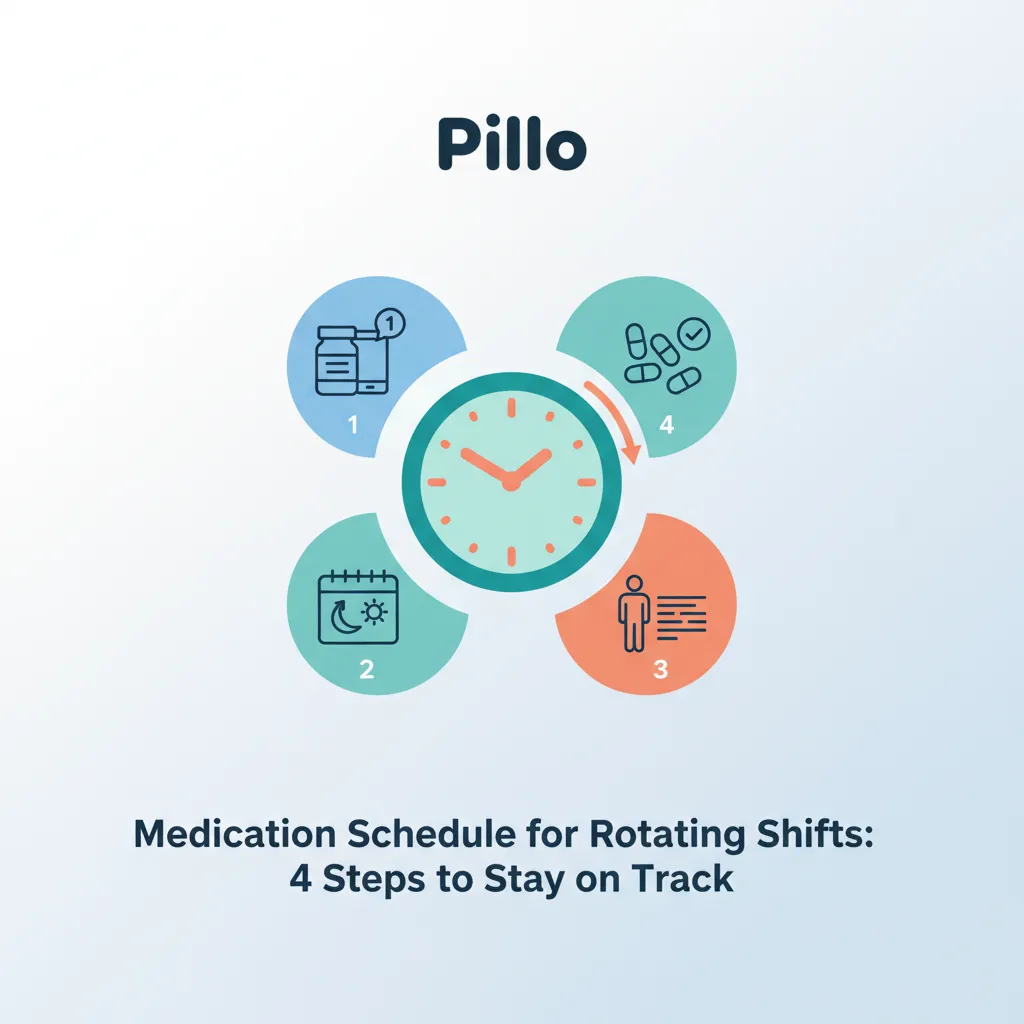
Anchor your medication to your sleep-wake cycle, not the clock. Take your "morning" dose when you wake up and your "evening" dose before bed, no matter what time that falls. During shift transitions, move your dose times gradually (1 to 2 hours per day) instead of jumping 8 or 12 hours all at once.
A free Android reminder app that follows your wake time helps on rotating shifts.
Why rotating shifts make medication harder than fixed schedules
Fixed night shift workers have it tough, but they can at least build one consistent routine. Rotating shift workers don't get that luxury. Your schedule flips every few days or weeks, and your medication timing has to flip with it.
The numbers back this up. A longitudinal study of 11,460 person-years found that shift workers had 16% higher odds of poor medication adherence compared to fixed daytime workers. The number one reason? Forgetting to take their medication. Not refusing, not skipping on purpose. Just forgetting, because the routine that normally triggers "time to take my pills" no longer exists.
This is not just an inconvenience. Research on chronopharmacology shows that the tolerability of nearly 500 medications can vary up to fivefold depending on when you take them. Your body's circadian clock controls how drugs are absorbed, processed, and cleared. When your sleep-wake cycle keeps shifting, your medication's performance shifts along with it.
Rotating shift workers also face compounding health risks. A study of industrial workers found that those on 3-shift rotations had 2.56 times the odds of developing metabolic syndrome compared to daytime workers. Managing medication well is not optional when your schedule already puts extra strain on your body.
If you work a fixed night shift, our dedicated night shift medication guide covers that scenario in detail. This guide focuses specifically on the challenge of constantly changing schedules.
Know your rotation type
Not all rotating schedules are the same, and your strategy should match your pattern. The table below breaks down the most common types:
| Rotation Type | How It Works | Transition Frequency | Medication Difficulty |
|---|---|---|---|
| Slow rotation (weekly+) | Same shift for 1-2 weeks, then switch | Every 1-2 weeks | Moderate: time to build a temporary routine |
| Fast rotation (2-3 days) | Shift changes every 2-3 days | Every few days | Hard: almost no time to settle into a pattern |
| 2-shift (day/night) | Alternating between two shifts | Varies | Moderate: only two schedules to plan for |
| 3-shift (day/evening/night) | Rotating through all three shifts | Varies | Hardest: three different dose timing plans needed |
| DuPont / Pitman | Named 12-hour patterns (e.g., 4 on, 3 off) | Built into the cycle | Moderate: predictable pattern once you learn it |
If you're on a slow rotation, you have enough time on each shift to treat it almost like a fixed schedule. Set your medication times when you start a new block and keep them steady until the next switch.
If you're on a fast rotation, a fixed approach won't work. You need a system built around your sleep-wake cycle, not specific clock times.
Step 1: Anchor doses to sleep, not the clock
The best strategy for rotating shift workers is to tie every dose to your sleep-wake cycle.
- "Morning" medication = when you wake up, whether that's 5 AM, 1 PM, or 9 PM
- "Evening" medication = before your sleep period, whenever that starts
- "With food" medication = with your first or last meal, regardless of the hour
For many medications, keeping a consistent interval between doses matters more than hitting an exact clock time. A blood pressure pill taken consistently every 24 hours is better than one taken erratically because you're trying to hit 8 AM on a night shift week. That said, some medications work best at certain times of day, and a few (like thyroid medication on an empty stomach) have strict conditions. Talk to your pharmacist about which of yours are flexible and which are not.
Step 2: Plan your transition days in advance
The shift changeover is where most doses get lost. Research on healthcare shift workers found that the transition from evening shifts to day shifts produced the worst sleep restriction, with workers averaging only 5.2 hours of sleep. When you're exhausted and your routine is disrupted, remembering a pill is the last thing on your mind.
Plan your transition doses before the switch happens, not during the chaos. Two approaches:
Gradual shift (best for slow rotations):
Move your dose time by 1 to 2 hours each day until you reach the new schedule. If you currently take medication at 10 PM and need to move to 6 AM, shift it to 12 AM, then 2 AM, then 4 AM, then 6 AM over four days.
Same-interval jump (for fast rotations):
If your shifts change every 2 to 3 days, gradual shifting isn't practical. Instead, keep the same interval from your wake-up time. If you always take your pill 30 minutes after waking, maintain that anchor point regardless of when you wake up.
Either way, never double up on doses to "catch up" after a transition. If you miss a dose, take it as soon as you remember unless it's close to the next scheduled dose.
Step 3: Build a system that survives schedule changes
Willpower alone won't keep you on track through rotating shifts. You need a system. Three approaches that work:
System 1: Pre-sort for the entire rotation block.
Before each rotation block starts, load a pill organizer for the full cycle. Label compartments by shift day (Day 1 AM, Day 1 PM, Day 2 AM, etc.) instead of traditional weekday labels. This way, you never have to think about which pills to grab at 3 AM after a double.
System 2: Pair doses with non-negotiable anchors.
Find something you do at every shift transition that never changes: brushing your teeth, eating your first meal, putting on your work badge. Build your medication into that anchor habit. The routine survives even when the clock time doesn't.
System 3: Use a reminder app that adapts.
Standard phone alarms set for fixed times fall apart on rotating schedules. You need reminders that adjust when your hours change and that won't let you accidentally ignore them during a hectic shift. If a silent notification at 2 AM during a busy shift is the only thing standing between you and a missed dose, that dose is getting missed.
For shift workers who need to take medication during work hours, keep a dose in your locker, bag, or break room so you don't have to go home to get it.
Step 4: Ask your pharmacist the right questions
Your pharmacist has specialized training in drug timing and absorption, and a quick conversation can save weeks of guesswork. Bring your actual rotation schedule and ask:
- "Which of my medications are time-sensitive?" Some need strict timing (seizure meds, certain blood pressure drugs). Others are flexible enough to move with your sleep cycle.
- "Can I shift my dose times gradually, or should I jump?" This depends on the specific drug, its half-life, and how your body processes it.
- "Are there extended-release versions?" Switching from a twice-daily to a once-daily formulation can cut the scheduling problem in half for people managing multiple medications.
If you're unsure whether taking a dose a couple of hours late is acceptable for your specific medication, that's another good question for your pharmacist.
How Pillo helps rotating shift workers
Rotating schedules are one of the hardest medication timing problems to solve. Pillo was built for exactly this kind of challenge.
Pillo's persistent alarm system keeps ringing until you acknowledge it. That matters at 3 AM during a hectic shift when a gentle notification would get swiped away without a second thought. You can set different persistence levels: a softer nudge for your pre-sleep dose, full nag mode for the mid-shift dose you're most likely to ignore.
For rotating schedules specifically:
- Complex schedule support handles different medication times for different days of the week, matching however your rotation is structured.
- Smart snooze auto-pauses reminders when you're on a call or driving home after a shift, then re-alerts when you arrive. No more "I'll take it when I get home" followed by passing out on the couch.
- Stock management tracks your pill count and alerts you before you run out, so you don't discover an empty bottle at 6 AM when the pharmacy is closed.
- Adherence reporting shows patterns in your missed doses, helping you spot which shift transitions cause the most problems.
Download Pillo on Google Play and set up your rotation schedule in a few minutes.
Frequently asked questions
Can I take my medication at different times each day on rotating shifts?
For most medications, yes, as long as you keep roughly the same interval between doses. A once-daily medication taken around the same time each day is fine for most drugs. The exception is medications with narrow therapeutic windows (like seizure medications or certain heart drugs), which need stricter timing. Check with your pharmacist about your specific medications.
What should I do on my days off: keep my shift schedule or switch to a normal one?
If your next shift block starts in a day or two, try to stay close to your shift schedule so the transition back is easier. If you have several days off, it's okay to shift toward a more typical sleep pattern, but do it gradually. Sudden 8 to 12 hour jumps in your schedule are the hardest on medication timing and your body.
How do I handle twice-daily medication on a rotating schedule?
Aim for roughly 12 hours between doses, anchored to your wake-up and pre-sleep times. If you wake at 2 PM for a night shift, take dose one at 2:30 PM and dose two at 2:30 AM. When your shift changes, adjust both times together to maintain that 12-hour gap.
I keep forgetting doses during shift transitions. What helps?
You're not alone. Forgetting is the top reason shift workers miss medication. The transition period is when your normal cues disappear. Two things that help most: pre-sorting your transition-day doses before the switch happens, and using a persistent reminder app that won't let a dose slip by silently. If you regularly can't remember whether you already took a dose, a tracking app or simple written log removes the guesswork.
Should I talk to my doctor about changing medications because of my shift schedule?
Talk to your doctor if you're consistently struggling. Some medications come in extended-release forms that require fewer daily doses. Others can be moved to once-daily dosing. Your doctor or pharmacist may also be able to consolidate your medication times so you're taking everything at one or two points in the day instead of three or four.
This article provides general information about medication management and is not a substitute for professional medical advice. Always consult your doctor or pharmacist before making changes to your medication schedule.