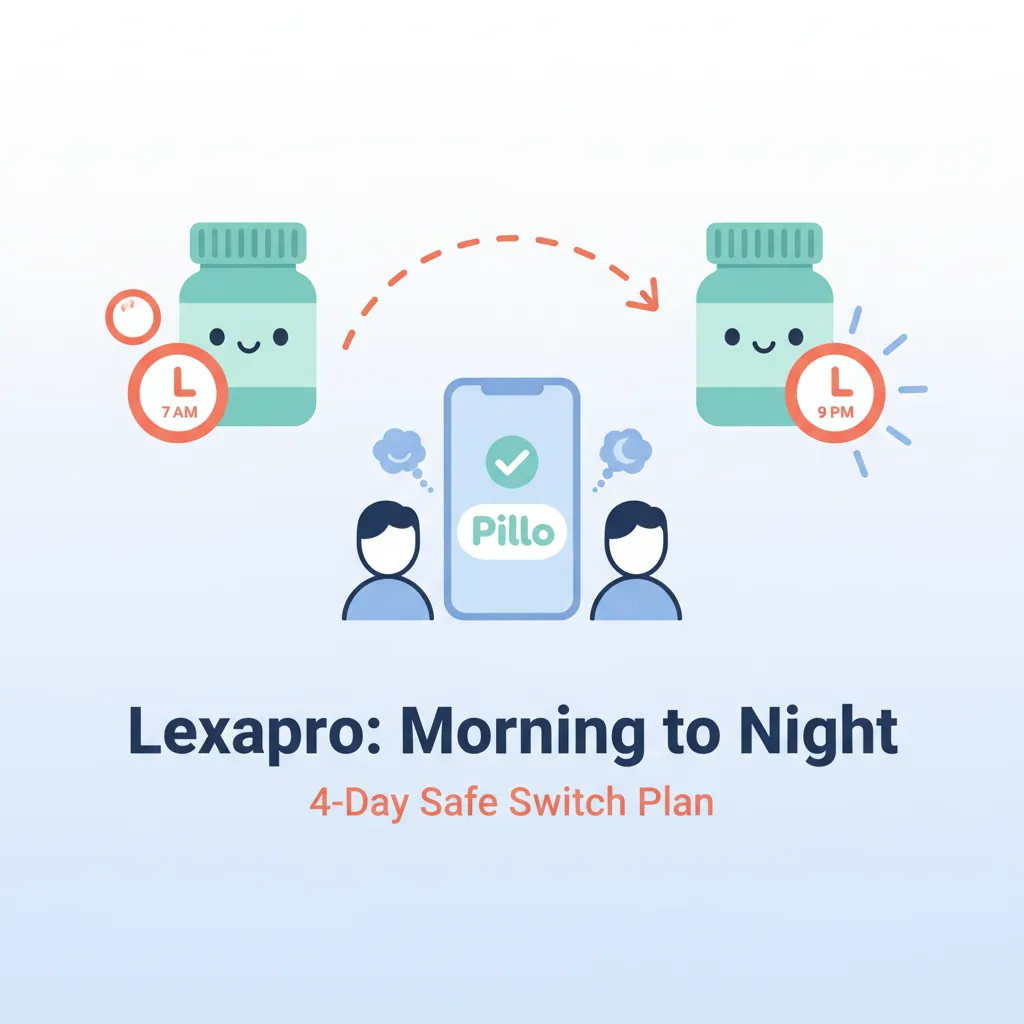
You can switch Lexapro timing without a taper or skipped dose. Escitalopram's 27 to 32 hour half-life is even longer than sertraline's, so a 3-hour daily shift over 4 days keeps your blood level above 90 percent of steady state. Direction depends on your symptoms: insomnia points toward morning dosing, daytime drowsiness points toward night.
Why Switching Lexapro Is Forgiving for Timing Changes
Most SSRI dosing advice treats timing changes like a high-stakes operation. With Lexapro that caution is overkill. The DailyMed Lexapro prescribing information lists a mean terminal half-life of 27 to 32 hours and a steady-state plasma level reached within one week of once-daily dosing. That is one of the longer half-lives in the SSRI class. The label itself says Lexapro can be taken "in the morning or evening, with or without food," so the timing window is wide by design.
The long half-life is the safety net. When the medication takes more than a day to halve in your blood, a small daily shift in dosing time produces a small trough dip, not a reset. Your serum level stays inside the therapeutic window the entire switch.
What this article does not cover: stopping Lexapro. Section 5.3 of the label on discontinuation syndrome calls for gradual dose reduction to avoid dysphoric mood, irritability, agitation, and dizziness when coming off the drug. Switching timing keeps you on a continuous daily dose, so discontinuation rules do not apply.
First: Decide Direction by Symptom
Important: this protocol assumes you are already on a stable Lexapro dose and your prescriber has approved a timing change. If you have not had that conversation, start there.
Lexapro causes both insomnia and daytime drowsiness, just at different rates. The Lexapro label's Table 2 puts the absolute incidence at 9 percent insomnia (versus 4 percent placebo) and 6 percent somnolence (versus 2 percent placebo). The 2023 dose-effect network meta-analysis in Sleep by Zhou et al. pooled trial data across 216 RCTs and found that for escitalopram specifically, somnolence vs placebo odds ratio was 2.87 (95 percent CI 2.04 to 4.04) while insomnia odds ratio was 1.37 (95 percent CI 1.08 to 1.75).
In plain terms: drowsiness on Lexapro is less common than insomnia in absolute numbers, but when it does happen it is much more clearly drug-related than the baseline. The direction you switch depends on which symptom you actually have.
| What you're feeling | Likely cause | Switch direction |
|---|---|---|
| Trouble falling asleep or staying asleep | Evening peak overlapping sleep window | Night to morning |
| Daytime grogginess or afternoon fog | Morning peak hitting during waking hours | Morning to night |
| Neither sleep disruption nor drowsiness | Current schedule is working | No switch unless lifestyle reason |
| Both insomnia and daytime drowsiness | Possibly dose-related, not timing | Call your prescriber first |
Lifestyle reasons are also valid. A schedule change, a partner with a conflicting alarm, or just a routine that stopped fitting. The same 4-day plan applies regardless of why you are switching.
The 4-Day Plan
Move your dose by 3 hours per day until you reach the new time. Pick a stable week for the switch, not the week before a big trip or major work event.
| Day | If switching from 9 AM to 9 PM | If switching from 10 PM to 7 AM |
|---|---|---|
| Day 1 | 12 PM (noon) | 7 PM |
| Day 2 | 3 PM | 4 PM |
| Day 3 | 6 PM | 1 PM |
| Day 4 | 9 PM (new time, hold here) | 10 AM |
| Day 5 | 9 PM | 7 AM (new time, hold here) |
A 3-hour daily shift on Lexapro drops your trough concentration by about 7 percent for that day, then recovers as the next dose absorbs. That is even smaller than the equivalent shift on sertraline, because Lexapro's half-life is longer. The trough stays comfortably inside the therapeutic window the whole time.
Quick math behind the plan Escitalopram follows first-order elimination kinetics. The fraction of yesterday's drug still present after a delay equals exp(-0.693 × delay_hours / 30) (using the midpoint of the 27 to 32 hour half-life range). A 3-hour delay leaves 93 percent. A 6-hour delay leaves 87 percent. A 12-hour delay leaves 76 percent. The 4-day plan keeps every daily fraction above 90 percent. That is even more forgiving than the equivalent plan for sertraline (26-hour half-life), where each daily fraction is around 92 percent.
If you take Lexapro at higher than 10 mg (some patients are on 20 mg for resistant depression or GAD), the math is the same. Dose magnitude does not change the half-life or the safe shift size. Talk to your prescriber if your current dose is 30 mg or higher, since that is above the labeled maximum.
Why You Don't Need to Skip a Dose
A common online recommendation is to "skip the old time and take it at the new time." That works on Lexapro because the long half-life forgives one extended interval. But it produces a sharper trough drop (about 24 percent for a 12-hour skip) than the 4-day plan needs to. The slower plan keeps daily drops under 8 percent the entire time.
Skipping also makes the next dose feel different. Some patients experience a transient mood or sleep effect after a 36-hour gap, which is mild but unnecessary if you can avoid it. The 4-day plan stays on a continuous daily dose, which keeps your steady-state stable.
The Lexapro label's Dosage and Administration section does not provide explicit guidance on switching dose timing, which leaves the "skip and shift" approach as patient folklore rather than label-supported instruction. The 4-day shift respects the label by keeping you on the labeled once-daily schedule.
Edge Cases
Night shift workers. Anchor Lexapro to your sleep period, not the wall clock. If you sleep from 9 AM to 5 PM, your "morning" Lexapro is around 5 PM and your "night" dose is around 8 AM. The 4-day plan still works, just translate the times to your sleep cycle.
Travel across time zones. For a 3 to 6 hour shift (US East Coast to Europe), do a one-day partial adjustment on arrival day. For 8+ hour shifts, run the 4-day plan starting on landing day with shorter increments.
You missed one of the switch days. Do not double up. Take the dose at the closest planned time you can manage and continue with the next day's planned time. If the gap stretches past 36 hours, see our guide on a missed dose of Lexapro.
You accidentally took two doses during the switch. Stop the switch, return to the schedule you were on before, and follow the guidance in accidentally took double dose of Lexapro before restarting the plan.
When to Call Your Prescriber
The 4-day plan is safe for most adults on a stable Lexapro dose. Call your prescriber before you start if any of the following apply:
- You are within the first 4 weeks of starting Lexapro or recently changed dose
- You have a history of bipolar disorder, mania, or hypomania
- You take an MAOI, lithium, tramadol, triptans, or other serotonergic drugs (serotonin syndrome risk per Section 5 of the label)
- You take warfarin, NSAIDs, or other anticoagulants
- You are pregnant or breastfeeding
- Your dose is 30 mg daily or higher
- You have liver impairment or are over 65 (the label notes slower clearance and recommends 10 mg/day max for older patients)
During the switch, contact your prescriber if you experience new agitation, suicidal thoughts, severe headache, tremor, confusion, high fever, or persistent insomnia lasting beyond a week.
How Pillo Helps the Switch
Switching Lexapro timing means resetting your alarm and then sticking to the new schedule for at least a week before evaluating. That is harder than it sounds. Your old time is muscle memory, and a generic phone notification you can swipe away does not interrupt that habit.
Pillo uses a persistent alarm that keeps firing until you log the dose. During a 4-day shifting protocol, that pattern fits the switch well. You can schedule the entire 4-day plan inside the app instead of manually reprogramming your phone alarm each morning. When you reach the new target time, the schedule view shows the steady cadence so you can confirm you are holding it.
For a structured protocol that applies to medications outside the SSRI class, see our how to switch medication times hub. For the same protocol applied to another SSRI, see how to switch sertraline timing. If you are still deciding whether morning or night is right for you, start with best time to take Lexapro before running the protocol on this page. For sertraline vs Lexapro context, see Lexapro vs Zoloft. Adjacent: switching blood pressure meds from night to morning covers the same timing-shift logic for a different drug class.
Frequently Asked Questions
Can I switch Lexapro from morning to night in one day?
You can. Lexapro's 27 to 32 hour half-life forgives one extended interval, and many patients do this without any symptoms. The trade-off is a roughly 24 percent trough drop for that one day, which can produce a brief sleep or mood dip. The 4-day plan above keeps daily drops under 8 percent and avoids that dip. If your prescriber has not said otherwise, the slower version is the lower-risk option.
How long should I wait before deciding the new timing isn't working?
Wait at least 7 to 14 stable days at the new time. Steady state on the new schedule takes about a week per the Lexapro label, so anything before day 7 reflects transition rather than the actual effect of the new timing. If you still feel worse after 14 stable days, call your prescriber rather than switching back on your own.
What if I switch from night to morning and now I'm drowsy in the afternoon?
Daytime drowsiness with a morning Lexapro dose is the most common reason patients switch back to evening. The label puts the somnolence incidence at 6 percent. If the drowsiness is mild, try the switch in reverse using the same 4-day plan. If it is severe or interferes with work, call your prescriber.
Will I get withdrawal symptoms during the switch?
No. The 4-day plan keeps you on a continuous daily dose, so there is no withdrawal. Discontinuation syndrome only happens when Lexapro is stopped or reduced, not when the time of day shifts. If you feel withdrawal-like symptoms (dizziness, electric-shock sensations, brain zaps) during the switch, you are likely missing a dose, not shifting it. Check your log and contact your prescriber.
Is switching Lexapro the same as switching escitalopram or any generic version?
Yes. Lexapro is the brand name, escitalopram is the generic. The 4-day plan is identical regardless of brand or manufacturer. Inactive ingredients vary slightly between manufacturers, but the active ingredient pharmacokinetics (half-life, steady state) do not change.
Can I take Lexapro at completely irregular times each day?
No. Lexapro relies on consistent daily dosing intervals to maintain steady state. Switching the time of day in a controlled 4-day plan is fine. Random daily variation is not, and over time it can produce serum-level swings that mimic missed doses. Pick a target time and hold it.
Will switching Lexapro timing affect how well it works?
No, as long as you stay on a daily dose throughout the switch. The 4-day plan keeps daily trough drops under 8 percent, which is well inside the therapeutic window. If you still feel worse after 7 to 14 stable days at the new time, the new time itself may not suit you. That is different from the medication losing efficacy.
A Note on Safety
This article provides general information about medication timing and is not a substitute for professional medical advice. Always consult your doctor or pharmacist before making changes to your medication schedule, especially if you take other prescriptions or have any of the conditions listed in the "When to Call Your Prescriber" section above.
Escitalopram-specific dosing decisions belong with your prescriber. The 4-day plan is a structure for how to execute a switch your prescriber has approved, not authorization to start one on your own.