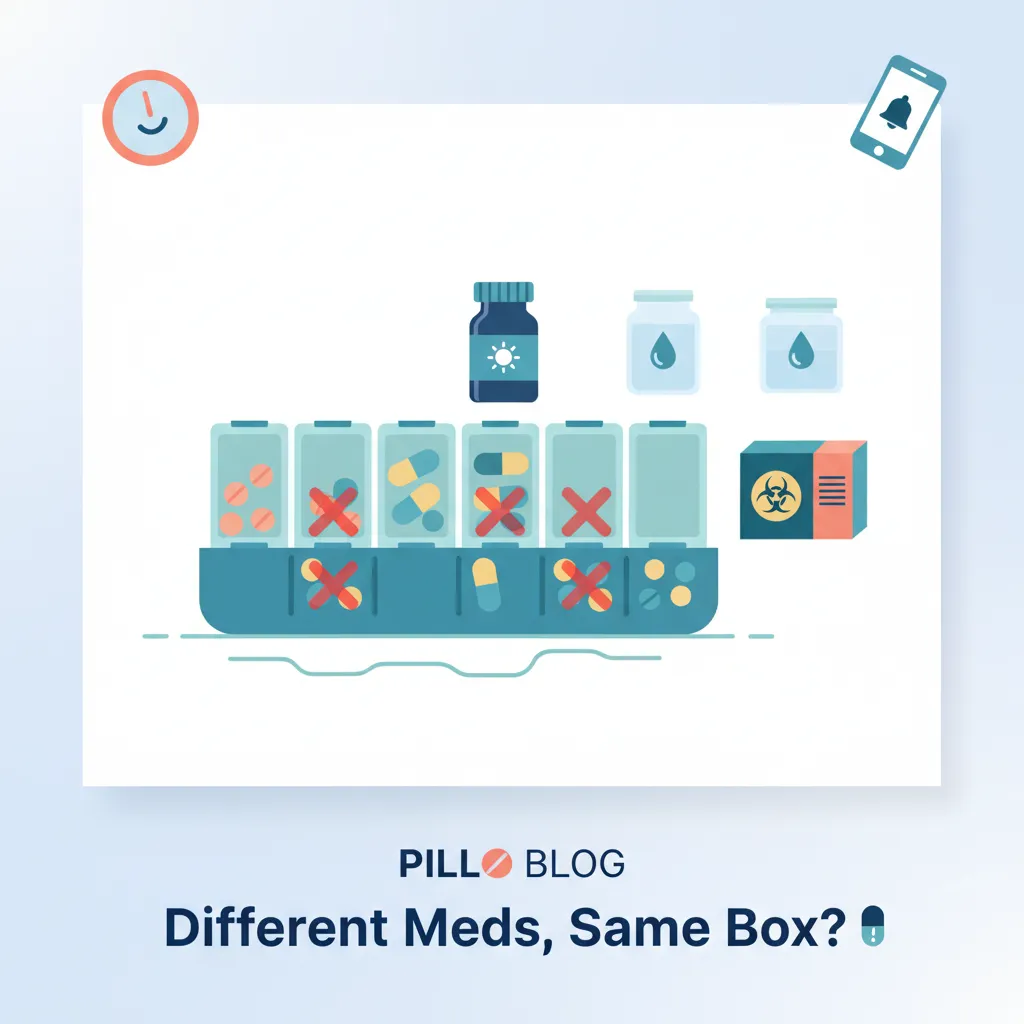
For most medications, yes. The drug labels we read do not warn about pills touching each other in a compartment. Their storage warnings are about moisture, light, and the original container. Storing pills together has barely been studied, so ask your pharmacist about anything new. Four specific drug categories need to stay in their original containers because of moisture, light, cytotoxic handling, or labeling rules. Here is the FDA-backed list.
This article cites FDA prescribing information and peer-reviewed safety research, but every medication regimen is unique. Talk with your doctor or pharmacist about your specific medications before changing how you store them.
What Is Actually Going On When Pills Touch
Most people who ask this question are worried about a chemistry problem. They picture two pills sitting next to each other in a pillbox and imagine some kind of reaction. When you check that worry against FDA labels and the published research, it is not what the warnings are about, though it has barely been tested.
Drug interactions happen when active ingredients dissolve in your gut and reach your bloodstream together. For two tablets touching in a dry plastic compartment, the labels we read give no warning, and the research is thin. In one study, atenolol tablets were stored together with aspirin in pill organizers for 28 days. The chemical stability of the atenolol was not affected, but one of the two atenolol brands got softer in the organizers, even at room temperature. For the other brand at room temperature, the data "provided evidence of short-term stability." In heat and high humidity, the uncoated aspirin tablets changed in appearance. A 2022 systematic review found "a significant shortage in the stability data" for medicines moved into pill organizers. So this has been tested for very few drugs. Ask your pharmacist about anything new.
What does matter is something different. Moisture, light, heat, and the risk of grabbing the wrong pill are real concerns, and these are what FDA labels warn about. The exclusion list below comes directly from drug labels and pharmacy safety research, not from chemistry of pill-on-pill contact.
The Four Categories That Should Not Go in a Pill Box
1. Moisture-Sensitive: Dabigatran (Pradaxa)
The FDA prescribing information for Pradaxa (dabigatran) instructs in two places: "Store PRADAXA in the original package to keep it dry," and "Store PRADAXA in the original package to protect from moisture." The label also requires patients to use the medication "within 30 days" once the bottle is opened.
This is not a soft suggestion. A 2017 stability study by Robertson et al. in the European Journal of Hospital Pharmacy tested what actually happens when dabigatran capsules are repackaged in dose administration aids (like weekly pillboxes). At 14 days in ambient humidity, the active drug content dropped to 92.5 percent and dissolution behavior changed. At 28 days, content fell to 71.6 percent, well below the 88.4 to 111.8 percent range US Pharmacopeia standards require. Capsules also developed pellet agglomeration and gel-like masses inside.
In plain language: dabigatran sitting in a pillbox for a month loses roughly a quarter of its potency. For a medication that prevents stroke in atrial fibrillation, that is a problem. If you take Pradaxa, ask your pharmacist about the safest routine. The 30-day bottle with built-in desiccant is doing chemistry your pillbox cannot replicate.
2. Light-Sensitive PRN: Sublingual Nitroglycerin
The FDA prescribing information for Nitrostat (nitroglycerin sublingual tablets) is direct: "Nitroglycerin should be kept in the original glass container and must be tightly capped after each use to prevent loss of tablet potency."
Two reasons sublingual nitroglycerin does not belong in a pillbox. First, nitroglycerin is volatile and loses potency when exposed to light, air, or plastic over time. Second, it is a PRN medication, taken when chest pain happens, not on a daily schedule. Pillboxes are designed for scheduled doses. Putting PRN nitroglycerin in a scheduled compartment defeats both the chemistry and the use case.
The original glass bottle is the medication's preservation system. Once you transfer the tablets out, the potency clock starts. If you take sublingual nitroglycerin, keep it in the original glass bottle. Ask your pharmacist how often the supply should be replaced based on your prescription date.
3. Cytotoxic: Methotrexate and Oral Chemotherapy
The FDA prescribing information for methotrexate tablets classifies the medication this way: "Methotrexate tablets are a cytotoxic drug. Follow applicable special handling and disposal procedures." The label references OSHA hazardous-drug handling guidelines.
There are two compounding risks for pillbox use. First, cytotoxic drugs require careful contact handling, especially around pregnant household members. When pills sit loose in a shared box, that handling is harder to control. Second, methotrexate for autoimmune conditions (rheumatoid arthritis, psoriasis) is dosed weekly. The Institute for Safe Medication Practices has tracked fatal errors involving accidental daily dosing of weekly methotrexate since 1996.
Memorial Sloan Kettering Cancer Center tells patients directly: "Some medicines are not safe to put in a pill box. This includes oral chemotherapy (chemo)." That guidance extends to other oral chemotherapy agents.
If you take weekly methotrexate or any oral chemotherapy, talk with your pharmacist about the safest storage and dosing routine. The bottle is your friend.
4. Drugs Labeled "Dispense in Original Container"
Some prescriptions arrive with explicit "dispense in original container" labeling. This usually reflects a stability or regulatory reason the manufacturer and FDA have built into the product. Categories commonly affected include hygroscopic anti-epileptics like phenytoin, certain controlled substances under state law, and clinical trial medications.
The instruction is part of the FDA-approved labeling, not a pharmacy preference. If you see this language on a bottle label, the answer to "can I put this in a pillbox" is no. Your pharmacist will flag this when filling the prescription. If you are unsure whether one of your medications carries this requirement, ask your pharmacist before transferring it.
Bonus: Form-Factor Exclusions
Beyond the four FDA-driven categories, MSKCC and pharmacy practice consistently exclude liquids, chewables, soft gel capsules, refrigerated drugs (insulin pens, injectable biologics), and any PRN medication from pillbox storage. These are physical-form mismatches, not chemistry concerns, but they fail the system for different reasons. A separate carrier or refrigerator tray works better for these.
The Real Risks (Moisture, Light, and Mix-Ups)
Pills touching each other is not what the labels and safety reports warn about. Three other concerns are.
The first is moisture and light degradation. Even drugs without an FDA original-container warning lose stability faster outside their packaging. Pharmacy consensus is to fill a pill organizer no more than one week ahead and to store it in a drawer or cabinet, not on a sunny countertop. The 2013 review by Borja-Oliveira in Revista de Saúde Pública framed it plainly: "Use of organizers for storing and carrying tablets and capsules exposes these medications to environmental factors from which their original packaging protected them, compromising their stability and safeness."
The second is mix-up risk when pills are unlabeled. ConsumerMedSafety documents a case where a patient took her father's Haldol (haloperidol) thinking it was her Zocor (simvastatin), because both had been transferred into an unlabeled prescription bottle for travel. She had severe muscle spasms. The lesson is not to avoid mixed pillboxes (which are labeled by day and time). The lesson is to never use unlabeled containers for transfer, and to keep loose pills out of mixed-purpose bottles.
The third is identification after spills. If you spill a labeled pillbox, you can usually re-sort by pill imprint and visual ID. If you spill loose pills from an unlabeled container, your pharmacist has to identify each one before you take any again.
The Setup That Works for Everything Else
| Setup choice | Why it works |
|---|---|
| Fill one week at a time, not monthly | Pharmacy consensus limits moisture and light exposure |
| Store in a drawer or cabinet, away from sun | Reduces light and heat degradation |
| Keep PRN medications in their original containers | PRN and scheduled meds have different access patterns |
| Label compartments by day and time | Eliminates the mix-up risk |
| Keep dabigatran, nitroglycerin SL, methotrexate, and oral chemo in original containers | FDA labels and oncology guidance specify |
| Maintain a digital dose log | Catches mix-ups after the fact and ends "did I take it" uncertainty |
A digital dose log eliminates the most common real risk (mix-up plus uncertainty about what you took). The pillbox handles sorting; the log handles the runtime answer. For the full setup walkthrough including the active-reminder layer, see Why a Pill Organizer Alone Won't Stop You Missing Doses. If you take 10 or more medications, capacity introduces its own breakdown points, covered in Pill Organizer for 10+ Medications.
A Pharmacy Conversation Checklist
When you start a new prescription, ask these four questions to know whether the pill belongs in your organizer:
- "Is this safe for a weekly pill organizer, or does it need to stay in the bottle?"
- "Does this medication have moisture or light sensitivity I should know about?"
- "Is this a scheduled daily medication, or PRN?"
- "If I use a 31-day organizer instead of a weekly one, does that change the answer?"
Most pharmacists know these answers on the spot. Asking takes 30 seconds and removes guesswork.
How Pillo Helps With Mix-Up Risk
A pill organizer handles the sort job: which pills go on which day and time. Pillo handles a job that an organizer cannot: a persistent alarm at dose time, a timestamped dose log, and separate tracking for scheduled versus PRN medications. The dose log is what eliminates the real mix-up risk above. If you took your morning Eliquis at 8 AM, the log shows it. The next day you do not have to wonder.
Pillo is free on the Google Play Store and works alongside any pillbox brand and any pharmacy. For the safety exclusion list above, the workflow is straightforward: scheduled meds go in the pillbox and onto the Pillo schedule. PRN meds (like nitroglycerin) get their own slot in the app with the bottle stored separately. Dabigatran and methotrexate stay in their original containers but appear in Pillo's tracking so refill reminders still fire.
Download Pillo on Google Play to set up the dose-log layer alongside your pillbox.
Frequently Asked Questions
Can I put my Eliquis or warfarin in a pill organizer?
It depends on which one. The Eliquis label we read has no original-container or moisture instruction for the tablets. Warfarin is different. The warfarin label tells patients: "Keep warfarin sodium tablets in a tightly closed container. Keep warfarin sodium tablets out of the light and moisture." Ask your pharmacist whether your organizer meets that before you move warfarin into it. Dabigatran (Pradaxa) is stricter: its label says to store it in the original package. See missed-dose-of-eliquis or missed-dose-of-warfarin for adherence guidance.
Do vitamins and prescription medications interact if stored in the same compartment?
The labels we read do not warn about it, and we did not find a study of vitamins stored with prescription pills. Storing pills together has barely been tested, so ask your pharmacist. The known issue is dose timing: some supplements like calcium and iron reduce absorption of certain medications when taken at the exact same minute. The fix for that is timing the doses apart at intake.
Will a silica gel desiccant pack in my pillbox protect moisture-sensitive medications?
A silica gel desiccant helps somewhat for general moisture protection, but it does not substitute for FDA-required original packaging. For dabigatran specifically, the original bottle comes with a desiccant and a 30-day stability rule built in. Repackaging defeats the FDA stability testing that the original packaging was designed around.
How long do non-exclusion drugs stay safe in a pillbox?
Pharmacy practice consensus is to fill no more than one week at a time. Many manufacturers test stability for short-term storage outside original packaging, but the data thins out beyond a week to a month depending on the drug. The Borja-Oliveira 2013 review framed extended out-of-package storage as compromising stability. One week is the safe default for non-exclusion medications.
What about a 31-day pillbox? Can I fill that for a month?
For most stable medications, a 31-day fill is acceptable if stored cool, dry, and dark. For moisture-sensitive medications (dabigatran being the clearest example), 31 days outside original packaging is too long. The Robertson 2017 stability data shows dabigatran content dropping to 71.6 percent at 28 days ambient. Always ask your pharmacist before extending the cycle for moisture-sensitive medications.
My pharmacy gave me compliance packaging (pre-sorted blister packs). Are those safer?
Generally yes. Pharmacy compliance packaging uses unit-dose blister packs under USP General Chapter 1146 repackaging standards, which include stability testing and moisture-vapor controls. The same exclusion categories still apply: drugs labeled "dispense in original container" generally cannot be transferred into compliance packaging either. Confirm exclusions with your pharmacist when starting.
What is the difference between dabigatran and the other blood thinners on this list?
Dabigatran (Pradaxa) has the strictest storage rule. Its label says: "Store in the original package to protect from moisture." The Eliquis and Xarelto tablet labels we read have no original-container or moisture instruction. The warfarin label does not call for the original container, but it tells patients to keep the tablets in a tightly closed container, out of the light and moisture. See Eliquis once vs twice a day and best-time-to-take-warfarin for anticoagulant-specific adherence guidance.
Can refrigerated storage extend how long Pradaxa stays stable in a pillbox?
Robertson 2017 found that refrigerated repackaging (2 to 8°C) preserved 98.2 percent drug content at 28 days, compared to 71.6 percent at ambient conditions. That is research data, not FDA guidance. The Pradaxa label still says to keep the capsules in the original package, which has a built-in desiccant. Refrigeration as a workaround is something to discuss with your pharmacist if your specific situation makes the original bottle impractical.
What about refrigerated medications like insulin pens or biologics?
Refrigerated medications belong on a labeled fridge tray, not in a room-temperature pillbox. Insulin pens, biologic injectables (Humira, Enbrel, others), and certain antibiotics require cold-chain storage. Use a separate carrier or fridge tray with day labels.
This article provides general information about medication storage and is not a substitute for professional medical advice. The drug-specific exclusions above are drawn from FDA prescribing information, but every medication regimen is unique. Always consult your doctor or pharmacist about your specific medications, especially if you are changing how you store or organize them.