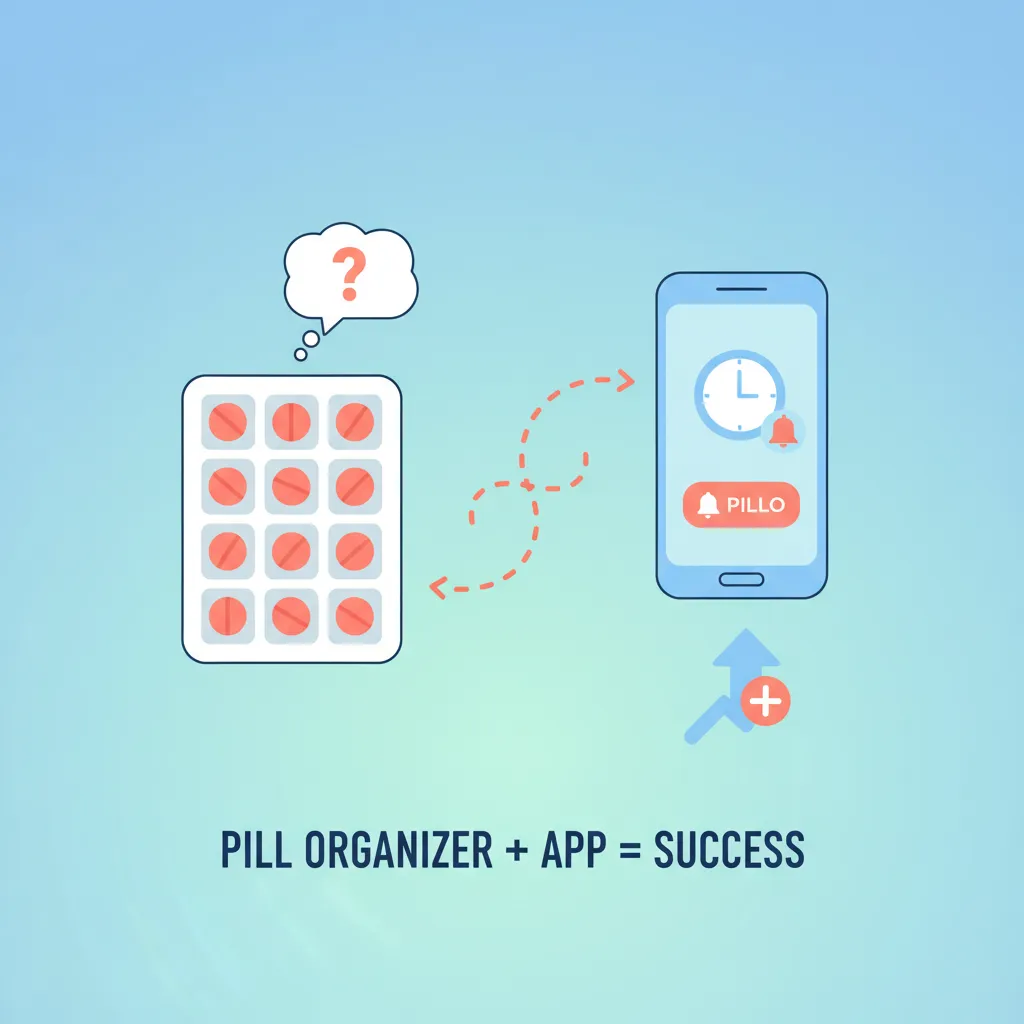
A pill organizer is excellent at one job. It sorts your week and shows which pills go on which day. But it never fires at dose time. That is why people who fill the box correctly still miss doses. The complete setup pairs the box with an active reminder app.
The Two Jobs You Are Actually Trying to Do
Most people buy a pill organizer with one goal: "I will stop forgetting my meds." When the organizer alone does not deliver that, frustration follows. The frustration is fair. The fix is not buying a smarter pillbox. The fix is recognizing two different jobs.
A pill organizer does the sort job. You fill it once at the start of the week. Each compartment holds the right pills for the right day and time slot. When a compartment sits empty, you can see at a glance that you took those pills. When it stays full, you can see you did not. It is genuine value, but it is not memory.
A medication reminder app does the firing job. It alarms at the dose time. It can keep alarming until you confirm. It logs the dose with a timestamp, so days later you can answer "did I take that?" with a real record instead of a guess.
These are two different layers. Neither replaces the other. A box that does not fire cannot solve forgetting any more than an alarm without a sort tool can solve confusion.
What the Research Actually Says
The data on pill organizers and reminder apps is more direct than most articles admit.
A 2024 randomized trial of 189 heart failure patients compared three groups: a pillbox organizer, a text reminder system, and a control group. Both intervention groups reached an adherence rate of 0.97, compared to 0.92 in the control. The improvements were statistically significant (p < 0.001). However, there was no significant difference between the pillbox group and the text reminder group (p = 0.978), according to FarzanehRad et al. 2024 in BMC Cardiovascular Disorders.
In plain language: either tool used alone produces similar improvement over doing nothing. Neither is meaningfully better than the other. That sets up the obvious next question. Does combining them produce a further gain?
A 2025 trial in the Indian Journal of Pharmacology tested exactly that. Sixty older adults were randomized to three arms: pillbox only, reminder app only, or both together. Across all three intervention groups, the share of participants who said they "never forget" their medication rose from 52 to 65 percent at baseline to 90 to 100 percent at the end of the study. Pill counts confirmed adherence above 80 percent in 94.74 to 100 percent of participants. The combination group reported the two tools as complementary, not burdensome, per Nimkar et al. 2025.
A 2025 meta-analysis pooled 14 randomized controlled trials of mobile medication reminder apps across diverse chronic conditions. Apps improved adherence by 18.85 percentage points on average (95% CI 2.17 to 35.53, p = 0.03). Ten of fourteen trials reached statistical significance on their own, according to Lanke et al. 2025 in JMIR.
Hardware-only solutions tell the other half of the story. The HeartStrong randomized trial in 2017 followed 1,509 patients after a heart attack. The intervention group received electronic "smart" pill bottles, a lottery incentive, and a social support option. The result: no significant reduction in time to rehospitalization compared to control, per the HeartStrong trial record (NCT01800201). Even high-end hardware did not move clinical outcomes when used as a single layer.
The pattern across these studies is consistent. A sort layer improves adherence. An active reminder layer improves adherence. Combining them appears to do more than either alone, and that combination does not require expensive hardware.
What an Effective Reminder App Has to Do
Not every app meets the bar. If you are pairing a reminder app with your pillbox, the app needs three specific features.
First, a persistent alarm. A reminder that fires once and times out silently is barely different from no reminder at all. The kind that matters keeps alerting until you confirm. This matches the design principle that distinguished the successful apps in the meta-analysis above.
Second, a timestamped dose log. When an empty compartment in your pillbox could mean "I took it" or "I forgot to fill it," memory cannot resolve the question. A timestamped log can. This is the layer that closes the loop on the box's biggest ambiguity.
Third, free and low-friction setup. An expensive hardware dispenser is not a requirement for the firing job. An app that runs on the phone already in your pocket can do the same work, and stays out of the way during the rest of the day when nothing is happening.
A general health app may not qualify. The Google Health app has no medication reminders, for example, even though it can show a medications list from synced U.S. records.
Several apps meet this bar. Pillo is one example. The alarm is persistent and keeps firing until you respond. The dose log records every confirmation with a timestamp. The app is free on the Play Store. It works alongside whatever pillbox brand you already own, since the app and the box do different jobs.
What a Pill Organizer Has to Do
The pillbox side is less complicated, but a few setup choices matter.
| Pillbox feature | Why it matters |
|---|---|
| AM and PM compartments minimum | A single-cell-per-day box collapses time-of-day separation, so morning and evening pills mix in one compartment. |
| Four-times-daily option | Required if any medication is taken four times a day. Otherwise you sort manually at runtime, defeating the box. |
| Compartment size larger than your largest pill | Big supplements and ER tablets need room. Cramming forces lids and risks spills. |
| Lid force under 2 pounds | Arthritis-friendly opening reduces filling errors and frustration on prep day. |
| Cool, dry, dark storage location | One week max fill prevents heat and moisture degradation. Drawer beats sunny countertop. |
If you take 10 or more medications, the standard 7-day pillbox may not have the capacity to do its sort job cleanly. We cover this in Pill Organizer for 10+ Medications. For people who prefer hardware that combines sort and active firing in one device, Pill Dispenser With Alarm walks through when that approach makes sense.
Setting Up the Combo in Seven Steps
The setup takes about 30 minutes. Do it on a quiet Saturday or Sunday before the next Monday morning dose.
- Choose the pillbox size. AM and PM compartments at minimum. Four-times-daily if any of your medications calls for that frequency. Do not compress doses into shared compartments.
- Fill it once a week. Lay out all bottles. Verify each compartment against the prescription label, one bottle at a time.
- Place the box where you will see it at dose time. A 2022 study in Frontiers in Digital Health found that storage in a nightstand drawer was significantly associated with lower odds of forgetting a dose, while storage in a kitchen cabinet was associated with higher odds of forgetting, according to Tucker et al. 2022. Counter level beats out-of-sight shelf.
- Install your reminder app. Persistent alarm and dose log are non-negotiable. If your app does not log doses with timestamps, switch apps.
- Set alarms for every scheduled dose time. Test that they actually fire by waiting through one full alarm cycle before Monday morning.
- Verify the dose log records correctly. The first confirmation should appear with a timestamp. Without a log, you have only the sort layer functioning.
- Run an audit on day 7. Empty cells should match logged confirmations. The two layers cross-check each other in a way neither does alone.
The two layers sync like this: the pillbox tells you what to take. The app tells you when, and records that you did. Working memory in adults tops out at about four meaningful items in active attention, according to Cowan's 2010 review. That is exactly the number most multi-medication routines exceed. Offloading "when" and "did I" to the app frees up the working memory the medication never needed to occupy in the first place.
What to Expect in the First Two Weeks
Habit formation research from University College London found that the median time to reach a stable, automatic habit is 66 days, with a range from 18 to 254 days. Missing one occasion did not derail the process, according to Lally et al. 2010.
That is two to nine months for a real habit to lock in. In the meantime, you cannot lean on the routine alone. That is exactly what the active reminder layer is for. The combination bridges the gap between "I am building this habit" and "the habit is automatic."
A simple two-week audit plan:
- Days 1 to 3: alarm fires, you confirm, box compartment empties. The three signals should line up. Tune alarm times if they collide with other commitments.
- Day 7: refill day. Count empty cells and compare to logged confirmations. If counts mismatch, walk back through which doses you missed and adjust placement or alarm.
- Day 14: full audit. Are you missing fewer doses than baseline? Are the logged times reasonable? Adjust placement or alarm timing if not.
If you keep missing the same dose despite both layers running, the problem is usually placement or alarm timing, not motivation. The troubleshooting walkthrough for repeated forgetting covers the next layer of fixes.
When the Combo Is Not Enough
The two-layer system handles most cases. A few situations call for an upgrade or adjustment.
- If you take 10 or more medications, the standard 7-day box runs out of capacity. See Pill Organizer for 10+ Medications for the upgrade path.
- Some medications, including dabigatran/Pradaxa, sublingual nitroglycerin, and oral chemotherapy drugs, must stay in their original containers because of moisture, light, or special handling requirements. The full list and reasons are in Can You Put Different Medications in the Same Pill Box?.
- Cognitive decline that prevents responding to a phone alarm may call for a locked hardware dispenser with caregiver alerts. The trade-off is cost and complexity.
- Patients just discharged from hospital with multiple new prescriptions can use the combo, but anchor it to a discharge-specific routine. See Medication Schedule After Hospital Discharge.
For most people taking 2 to 8 daily medications, the combination of any reasonable pillbox plus a free reminder app with persistent alarm and dose log does the work that hardware dispensers cost hundreds of dollars to do. The category matters more than the brand.
How Pillo Fits the Reminder Side
If you are looking for the reminder-app half of the combination, Pillo is built around the three requirements covered above. The alarm is persistent: it keeps going until you confirm you took the dose. The dose log records every confirmation with a timestamp, so the empty-compartment ambiguity does not become a memory problem days later. The app is free on the Google Play Store. It works alongside whatever pillbox you already own, since the two tools handle different jobs.
Download Pillo on Google Play to set up the reminder side of your combo.
Frequently Asked Questions
Will a fancier or smart pillbox solve the missed-dose problem on its own?
Probably not, based on the evidence. The HeartStrong trial gave 1,500 post-heart-attack patients smart electronic pill bottles with reminders, lottery incentives, and social support, and found no significant difference in rehospitalization rates. The active reminder and the dose log usually need to be separate layers, working alongside the sort tool.
Is the combination worth setting up if I only take two medications?
Yes, especially if you have ever missed a dose. The empty-compartment ambiguity, "did I take it, or did I forget to fill it," shows up at any number of medications. A dose log resolves the ambiguity at any scale.
What if I forget to refill the pillbox itself?
This is a real failure mode and easy to fix. Set a recurring weekly alarm in your reminder app for Sunday refill time. The same persistent-alarm logic that catches missed doses catches missed refills.
Can I use the combo if I am a caregiver filling a pillbox for someone else?
Yes. The caregiver typically owns the filling step. The reminder app can run on the patient's phone, the caregiver's phone, or both, depending on who is in earshot at dose time. The dose log gives the caregiver a way to confirm doses without nagging.
What about drugs that should not go in a pillbox at all?
Some medications need to stay in their original containers because of moisture, light sensitivity, or special handling requirements. The full list and reasons are in Can You Put Different Medications in the Same Pill Box?.
How long until the routine sticks on its own?
Habit research suggests a median of about 66 days for a new behavior to become automatic, with wide individual variation. The combination bridges that two-to-nine-month window. Even after the habit forms, the dose log remains useful for the moments when life disrupts the routine.
Is a pill organizer worth using at all if I have a reminder app?
Yes, for most people on more than two medications. The sort job is real value: without the organizer you would be reading prescription bottles before every dose. The combo gives you the visual confirmation layer (compartment empty or full) that an app cannot provide on its own, and the dose log that a pillbox cannot keep. Each tool covers a job the other is not built for.
This article provides general information about medication management and is not a substitute for professional medical advice. Always consult your doctor or pharmacist before making changes to your medication schedule.