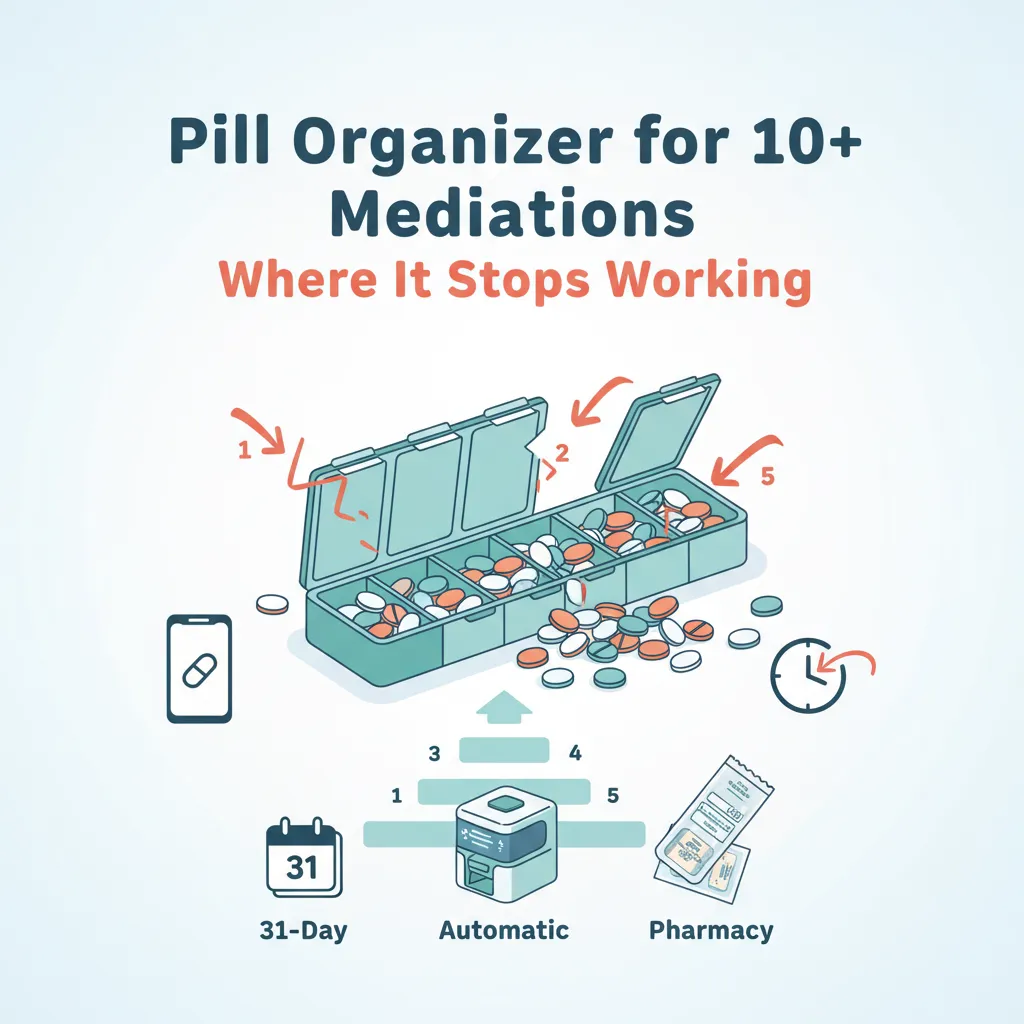
A standard 7-day, 4-times-per-day pillbox has 28 compartments. Taking 10 medications generates 70+ pills per week. At that scale, compartments overflow, AM and PM mix, and PRN tracking falls apart. Here is where the plastic box stops working, and the upgrade path that addresses each failure.
Why Polypharmacy Math Breaks the Standard Pillbox
If you take 10 or more daily medications, you are in good company. A 2023 NHANES analysis of 55,081 adults found that polypharmacy prevalence among Americans aged 65 and older rose from 23.5 percent in 1999-2000 to 44.1 percent in 2017-2018. The American Geriatrics Society defines polypharmacy as five or more concurrent prescription drugs in the 2023 Beers Criteria, and that threshold now describes the majority of older adults in the United States.
The stakes are real. A BMJ prospective analysis of 18,820 patients (Pirmohamed et al. 2004) found that adverse drug reactions cause 6.5 percent of all hospital admissions, accounting for 4 percent of bed capacity. A separate nationwide cohort study in Scientific Reports found polypharmacy in elderly patients associated with an adjusted hazard ratio of 1.18 for hospitalization. The standard 7-day weekly pill organizer was not built for this load. It works fine at two or three medications. At ten or more, the math runs out of compartments and the system breaks down.
The Math: 28 Compartments vs 70+ Pills
A standard weekly box has four time slots per day (AM, Noon, PM, Bed). Seven days times four slots equals 28 compartments. Take ten medications, twice daily, and you place 140 pills per week. Three times daily pushes 210. Even with mostly once-daily medications and a few split doses, you are still cramming 70+ pills into 28 cells.
Space is only part of it. Working memory in adults has a central capacity limit of about four meaningful items, per Cowan 2010. A weekly pillbox visualization at 10 medications exceeds that limit dozens of times over. The compartments stop functioning as memory aids and start functioning as confusion sources.
The 5 Physical Breakdown Points
At polypharmacy scale, a standard 7-day organizer breaks down in five specific places.
1. Compartment Overflow
Large pills like metformin 500mg extended-release, fish-oil softgels, and calcium citrate 600mg physically exceed standard cell volume. Eight pills crammed in a single AM compartment means lids force shut or pop open in transit. Spilled pills get lost, mixed, or thrown out.
2. Time-Slot Collapse
AM and Noon compartments within the same day cell sit millimeters apart in most weekly organizers. At ten medications, pills migrate between compartments during the Sunday fill. By Friday, you are sorting by hand at the dose moment to figure out what is AM versus Noon, defeating the entire sort purpose.
3. PRN Drift
Scheduled medications and as-needed medications (pain relief, anxiety, nitroglycerin) follow different access patterns. Mixing them in the same compartment makes counting impossible. By refill time, you cannot tell how much PRN you took versus how much scheduled, which masks adherence problems for weeks.
4. Refill Cycle Mismatch
30-day refills, 90-day refills, and PRN refills do not synchronize. When you fill the box for the week, your pharmacist's mental math becomes your math. Some bottles are short, others are long, and the refill calendar slips. Skipped doses appear when a single med runs out two days before the next refill.
5. Travel Split
You take three days of pills into a travel pouch, leaving four days in the home box. Returning, you count back to verify, but if any pills shifted between compartments while traveling, the audit fails. Doses get missed or doubled to "catch up."
The Upgrade Ladder
Polypharmacy patients usually move through the same upgrade sequence. Here is the honest path with what each tier solves and where it stops.
| Tier | Capacity | Solves | Stops working at |
|---|---|---|---|
| 7-day basic ($5-15) | 28 compartments (AM/Noon/PM/Bed) | 2-4 daily meds with simple schedules | 5+ meds with multiple daily doses |
| 31-day large-compartment ($15-40) | 31-124 compartments depending on time-slot config | 10+ once-daily meds, or 5-7 meds with 2x daily | 10+ meds with 3-4 daily doses |
| Multiple 7-day boxes (one per time slot) | Unlimited (one box per AM/Noon/PM/Bed) | Volume issues | Cognitive load multiplies; tracking becomes harder |
| Automatic dispenser (Hero, MOBI, $100-1000) | MOBI: 28-day x 35 tablets per slot x 9 daily doses. Hero: 90-day supply of up to 10 medications. | Volume + active alarm + locked storage | PRN tracking (most do not handle as-needed meds); cost |
| Pharmacy compliance packaging (blister packs) | Pharmacy pre-sorts by day and time | Filling errors and capacity at the same time | Drugs labeled "dispense in original container" still excluded |
A Conn et al. 2014 systematic review and meta-analysis in Current Medical Research and Opinion (N = 22,858 across 52 reports) found that blister pack compliance packaging produced an effect size of 0.802 on adherence versus 0.384 for standard pill boxes. For polypharmacy specifically, compliance packaging is one of the strongest evidence-backed tiers.
For drugs that should not go in any tier above (moisture-sensitive, light-sensitive, cytotoxic, or original-container-labeled), see Can You Put Different Medications in the Same Pill Box? for the exclusion list.
The Step Most Roundups Skip: The Active Reminder Layer
Sorting handles which pills to take. It does not handle when, or whether you actually took them. A 2024 heart failure RCT in BMC Cardiovascular Disorders with 189 patients found that pillbox alone improved adherence to 0.97 versus 0.92 in control (p < 0.001), but a text reminder produced the same result. Neither outperformed the other when used alone.
A 2025 trial in the Indian Journal of Pharmacology tested the combination directly. Sixty older adults were randomized to three arms: pillbox only, reminder app only, or combined. Across all intervention groups, the share of patients reporting "never forget" rose from 52-65 percent at baseline to 90-100 percent at the end. The combination group reported the two tools as complementary, not burdensome.
For polypharmacy patients, the practical takeaway is: whichever organizer tier you choose, add an active reminder layer. The pillbox or dispenser sorts. The reminder fires and logs. The two layers cover different jobs. For the complete setup walkthrough, see Why a Pill Organizer Alone Won't Stop You Missing Doses.
How Pillo Fits the Reminder Layer
If you take 10 or more medications, Pillo provides the reminder and dose-log layer that pairs with whatever organizer or dispenser you use. The app tracks scheduled and PRN medications separately, so the PRN drift problem above does not happen. It logs every confirmed dose with a timestamp, so the refill audit becomes straightforward. The alarm is persistent and keeps firing until you confirm.
Pillo is free on the Google Play Store. It works alongside your pillbox, your 31-day organizer, your hardware dispenser, or compliance packaging from your pharmacy. The category matters more than the brand: persistent alarm + dose log + free is the bar.
Download Pillo on Google Play to set up the reminder layer for your polypharmacy routine.
When to Talk With Your Pharmacist About Deprescribing
Sometimes the right answer is not a bigger pillbox or a smarter app. The AGS 2023 Beers Criteria flag polypharmacy as a clinical concern requiring periodic medication review. If your pillbox keeps overflowing and your refill calendar keeps slipping, your pharmacist can often identify medications that no longer have clear benefit, drugs duplicated by therapeutic class, or supplements worth discussing with your prescriber.
A 30-minute pharmacist consultation often finds at least one medication that can be tapered or stopped. See Too Many Medications After Hospital Discharge for the deprescribing conversation context, and Questions to Ask Your Pharmacist After Hospital Discharge for a starting checklist.
Frequently Asked Questions
Should I get a Hero or other automatic dispenser if I take 10+ medications?
A hardware dispenser may help if your main problems are capacity, active alarming, and locked storage (for cognitive decline or controlled substances). A typical dispenser handles 10-28 days of supply across multiple daily doses. They do not handle PRN medications well, and they cost $100 to $1,000 plus monthly subscription in some cases. For most polypharmacy patients, a combination of a 31-day organizer plus a free reminder app produces similar outcomes at lower cost.
What about pharmacy compliance packaging (multimed blister packs)?
Pharmacy compliance packaging is one of the strongest evidence-backed options for polypharmacy. A Conn 2014 meta-analysis in Current Medical Research and Opinion found blister packs roughly doubled the effect of standard pillboxes on adherence (0.802 vs 0.384 standardized effect size). Many pharmacies offer this service free or at minimal cost. Ask your pharmacist whether your prescriptions can be packaged this way. The same drug-exclusion list still applies (some drugs stay in original containers).
When should I ask my doctor about deprescribing?
Triggers include: filling your pillbox takes more than 20 minutes, you cannot remember why you take certain medications, you are taking medications from the same therapeutic class (multiple PPIs, multiple antihypertensives at low doses), or you have had an adverse drug event. Adults 65 and older taking 5+ medications benefit from regular medication review with their pharmacist or doctor, per AGS Beers Criteria guidance on polypharmacy.
How do I handle PRN medications when I am on polypharmacy?
PRN medications belong in their original containers, separate from your scheduled pillbox. Use a labeled travel pouch or original bottles for PRN access. A reminder app tracks scheduled and PRN doses in separate logs, which is important when discussing usage with your prescriber.
Can I use multiple smaller pillboxes instead of one large one?
Yes, and this is a real strategy for polypharmacy. The MedlinePlus medication organization guide suggests using a separate 7-day box for each time of day (one for AM, one for PM, etc.). This solves the capacity problem but multiplies the cognitive load. An active reminder app that fires at each dose time helps coordinate the multiple boxes.
How long does it take to fill a pillbox at 10+ medications?
Pharmacy practice suggests 15 to 30 minutes for a careful fill at 10+ medications, with the bottles laid out and each compartment verified against the prescription label. Rushing produces errors. Many pharmacies offer free pillbox filling with pharmacist verification, which cuts errors significantly. Ask your local pharmacy whether this service is available.
What if I am the caregiver filling for someone else?
One person should own the meds to avoid handoff errors. The same upgrade ladder applies. A reminder app on the patient's phone (or the caregiver's phone with patient in earshot) lets you confirm doses without nagging. Photograph the filled box each week as an audit trail. See Helping a Parent With Medications After Hospital Discharge for caregiver-specific guidance.
Does Medicare or private insurance cover automatic pill dispensers?
Generally not as a routine benefit. Most automatic pill dispensers are paid out of pocket. Some Medicare Advantage plans include Durable Medical Equipment (DME) benefits that may cover dispensers in specific clinical scenarios (cognitive decline, post-stroke, certain Medicaid programs). The exception is pharmacy compliance packaging, which most retail pharmacies offer at no extra cost to the patient. Ask your pharmacist whether your prescriptions are eligible for multidose blister packaging through their service.
This article provides general information about medication management and is not a substitute for professional medical advice. Always consult your doctor or pharmacist before changing how you organize or take your medications.