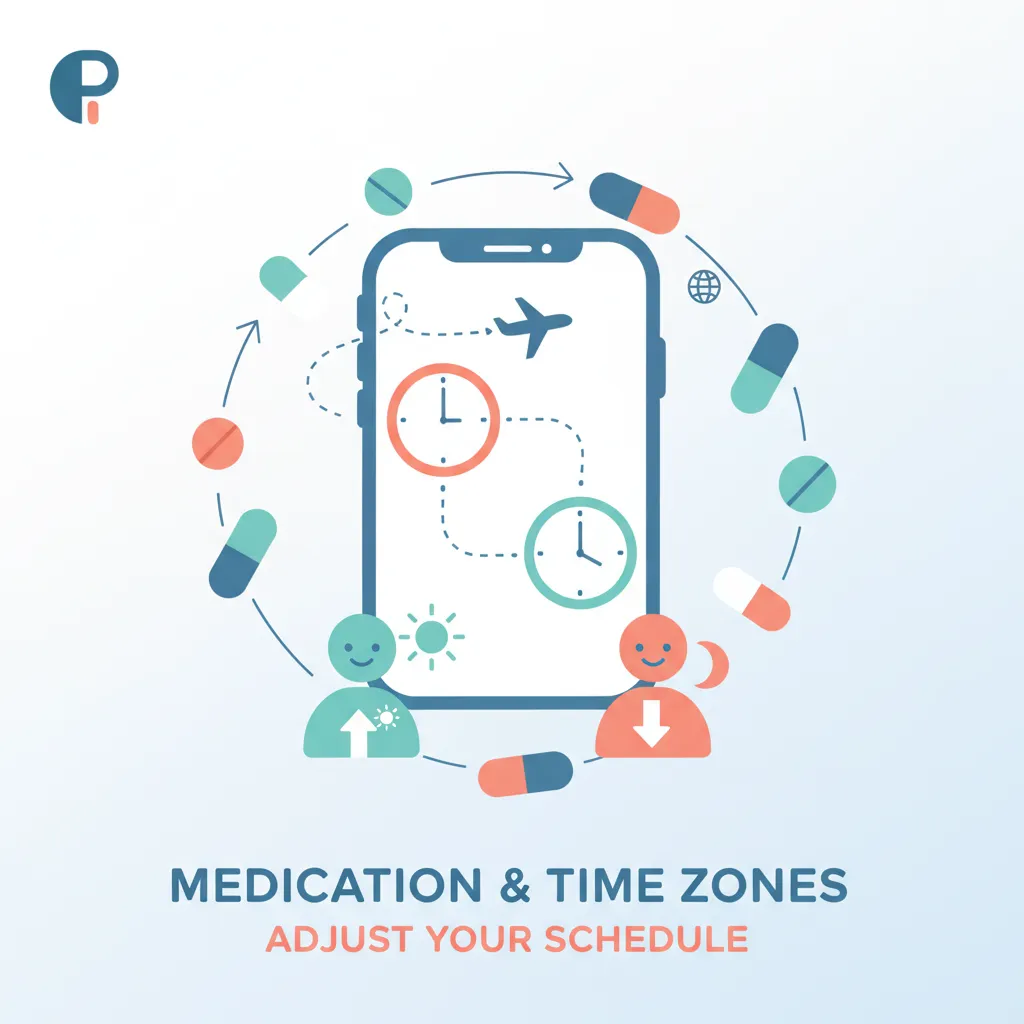
When you fly across time zones, take your medication based on the hours since your last dose, not the local clock. According to the CDC, counting elapsed time keeps your drug levels steady while your body adjusts to the new schedule.
Why time zones throw off your medication routine
Flying from New York to London doesn't just give you jet lag. It also shortens your day by five hours, which can squeeze two doses too close together or force you to skip one entirely. Your body notices.
A study in the Journal of Travel Medicine found that 60% of immigrant travelers on extended trips became nonadherent to their medications during travel. On top of that, 32% experienced health problems related to their chronic disease while traveling. And only 16% of pre-travel medical advice addressed chronic medication management at all.
The problem goes beyond just remembering to take your pills. Your body's internal clock affects how it processes drugs. A review in Expert Opinion on Drug Metabolism & Toxicology showed that drug absorption, liver metabolism, and kidney clearance all follow circadian rhythms. A pill taken at your usual 8 AM body time may behave differently when your body thinks it's 3 AM.
The good news: most medications are more forgiving than you think. A few need careful planning, but the majority can handle a gradual shift without any problems.
Which medications are time-sensitive? (And Which Aren't)
Not every medication reacts the same way to a schedule shift. Before your trip, figure out where your medications fall on this spectrum.
| Sensitivity Level | Medication Type | How Much Flexibility? | Travel Note |
|---|---|---|---|
| Strict timing | Insulin | Tied to meals and activity | Eastbound = shorter day (may need less). Westbound = longer day (may need extra). CDC |
| Strict timing | Progestin-only birth control (mini-pill) | Must stay within a 3-hour window | More than 3 hours late = backup contraception for 48 hours. ACOG |
| Strict timing | Warfarin (blood thinner) | Same time daily | Take a missed dose as soon as you remember on the same day. If it's nearly time for your next dose, skip the missed one. Never double up. Cleveland Clinic |
| Moderate | Levothyroxine (thyroid) | Must be on an empty stomach, 30-60 min before food | Timing shift is OK if you keep the fasting requirement. Bach-Huynh et al., JCEM |
| Moderate | Combination birth control | 1-2 hours late is fine | Miss one pill? Take it ASAP, even if that means two in one day. Miss two or more? Use backup contraception for 7 days. Planned Parenthood |
| Moderate | Blood pressure medications | Flexible within a few hours | Keep roughly 24-hour intervals between doses. |
| Flexible | Statins (cholesterol medications) | A few hours off is fine | Long half-lives make timing less critical. |
| Flexible | Metformin (diabetes) | Take with meals at your destination | Follows your meal schedule, not the clock. |
If you take medications that need to be on an empty stomach, plan your travel meals around those requirements. A study on levothyroxine found that taking it with breakfast instead of fasting nearly tripled TSH levels (1.06 vs. 2.93 mIU/L), so keeping the fasting window matters more than the exact hour.
Traveling east: your day gets shorter
Flying east (say, New York to London or Los Angeles to Tokyo) shrinks your day. If you normally take a pill at 8 AM Eastern and land in London at 1 PM local time, your body still thinks it's 8 AM. That lost time can push two doses dangerously close together.
Step-by-step adjustment for eastbound travel:
- Before you fly, keep taking your medication at your normal home time.
- During the flight, set a phone alarm for your next dose based on hours since your last one, not the destination clock. If you take your pill every 24 hours and last took it at 8 AM before departure, your next dose is 24 hours later regardless of what the clock on the plane says.
- On arrival, start shifting your dose by 1-2 hours per day toward the local schedule. For a 6-hour time difference, this takes about 3-4 days.
- For strict-timing medications, talk to your doctor before the trip. Insulin users flying east may need a slightly smaller dose on travel day because the shortened day means less time between meals (CDC Diabetes Travel Tips).
Example: You take blood pressure medication at 8 AM EST and fly to London (5 hours ahead). Day 1 in London, take it at 1 PM local (still 8 AM body time). Day 2, shift to 11 AM local. Day 3, shift to 9 AM. By Day 4, you're at 8 AM London time.
If your medication is typically taken in the morning and you're worried about the shift, keep in mind that most once-daily medications can safely slide a couple of hours without losing effectiveness.
Traveling west: your day gets longer
Flying west (London to New York, Tokyo to Los Angeles) stretches your day. You gain hours, which means the gap between doses gets longer. For most medications this is easier to manage than eastbound travel, but drugs with shorter half-lives may leave you without enough coverage during the extended day.
Step-by-step adjustment for westbound travel:
- Before you fly, take your medication at the usual time.
- During the flight, if the extended day means you'll go significantly longer than your normal interval (more than 4-6 extra hours), you may need a small extra dose. This applies mainly to insulin and short half-life drugs. Confirm with your prescriber before traveling.
- On arrival, start shifting your dose by 1-2 hours per day. Since your day was longer, you may already be close to the local schedule.
- For insulin users, the longer day may require an extra small dose of short-acting insulin to cover the additional meals. Check blood sugar more frequently on arrival day (CDC).
Example: You take thyroid medication at 7 AM London time and fly to New York (5 hours behind). On arrival day, 7 AM London time is 2 AM in New York, so you already took your pill before the flight. The next morning, take it at 7 AM New York time. Since the gap is about 29 hours (longer than usual), levothyroxine's long half-life makes this safe. Just maintain the empty stomach requirement.
Quick tips for specific drug types
Birth control: Keep taking your pill based on home time for the entire trip if it's short (under a week). For longer stays, gradually shift to local time. Progestin-only pills have zero room for error beyond 3 hours (ACOG). Combination pills are more forgiving. If you miss a dose of birth control, follow catch-up protocols immediately.
Blood thinners: Warfarin timing should stay consistent. If you miss a warfarin dose and more than 8 hours have passed, skip it entirely. For extended international trips, the Cleveland Clinic recommends finding a lab at your destination for INR monitoring.
Diabetes medications: Metformin follows your meals, so simply take it with food at the local mealtime. Insulin requires more planning because dosing depends on meals, activity, and the length of your travel day. Check blood sugar often during the first 48 hours after arrival.
Antidepressants: Most SSRIs and SNRIs have long enough half-lives to tolerate a gradual shift. However, if you take a short half-life antidepressant like venlafaxine or paroxetine, even a few hours late can trigger withdrawal-like symptoms (more details). Plan the transition more carefully for these.
Before you fly: a packing and planning checklist
The CDC and Cleveland Clinic recommend these steps:
- Pack medications in your carry-on bag. Never put them in checked luggage. Lost luggage means lost medication.
- Bring extra supply. Pack enough for the full trip plus extras in case of delays.
- Keep pills in original pharmacy-labeled containers. The TSA does not require this, but state and international laws may.
- Carry a doctor's letter. List all medications by generic name and dosage. The WHO notes that some countries (especially for psychotropic medications) require written proof of medical necessity.
- Check destination drug laws. Some over-the-counter medications in the U.S. are controlled substances abroad. Contact the destination country's embassy.
- Discuss any planned medication changes with your doctor well before a long trip. The CDC recommends pre-travel consultation at least 4-6 weeks before departure.
- Write down your schedule. Note each medication, your home-time dose, and the local-time equivalent. If you manage multiple medications, a written plan prevents confusion.
If you've ever forgotten your medication on vacation, you know how stressful catching up can be. Preparation eliminates that problem.
How Pillo keeps you on track across time zones
Adjusting medication timing across time zones requires reliable, hard-to-ignore reminders at unfamiliar hours. That's where Pillo fits in.
Pillo's persistent alarm system keeps ringing until you confirm you've taken your dose. When you're jet-lagged and half-asleep at 3 AM because your body thinks it's morning, a standard notification is easy to swipe away. A persistent alarm that won't stop? Not so much.
You can set complex medication schedules with different times for each day of your trip, then adjust those times as you gradually shift to the local time zone. If you're on five medications with different timing requirements, Pillo handles each one independently.
The stock management feature also helps with trip prep. You can check how many pills you have left and set refill reminders so you never discover you're short the night before a flight.
And if your travel routine gets disrupted and you can't remember if you already took your medication, Pillo's adherence reporting shows exactly when you last confirmed a dose.
Frequently asked questions
Can I skip a dose to sync up with the local time zone?
For most medications, no. Skipping a dose creates a gap in your drug levels that can cause symptoms or health problems. Instead, gradually shift your dose time by 1-2 hours per day until you reach the local schedule. If the time difference is small (1-3 hours), you can shift your medication time in a single step for most drugs.
What if my flight gets delayed by several hours?
Take your medication at the scheduled time regardless of the delay. Set an alarm based on hours since your last dose. If you're stuck at the airport and it's time for a dose, take it. Your schedule follows your body, not your itinerary.
Do I adjust on the plane or wait until I land?
Start adjusting on the plane if you have a long flight. Take your next dose based on elapsed time since your last one. Once you land, begin the gradual 1-2 hour daily shift toward the local schedule.
How does daylight saving time compare to crossing time zones?
Daylight saving time is only a 1-hour shift, which most medications can absorb without any adjustment. For the full breakdown, read our guide on daylight saving time and medication schedules. Crossing multiple time zones (3+ hours) requires the gradual adjustment approach described above.
Should I talk to my doctor before an international trip?
Yes, especially if you take insulin, blood thinners, or any medication with strict timing requirements. Your doctor can write a medication letter for customs, adjust your dosing plan for the specific time difference, and advise on any destination-specific concerns. The CDC recommends discussing medication timing during pre-travel consultations.
If remembering doses is the hard part, a pill reminder app that keeps alarming until you respond can take that job off your plate.
This article is for informational purposes only and does not replace professional medical advice. Consult your doctor or pharmacist for advice specific to your medications before traveling internationally.