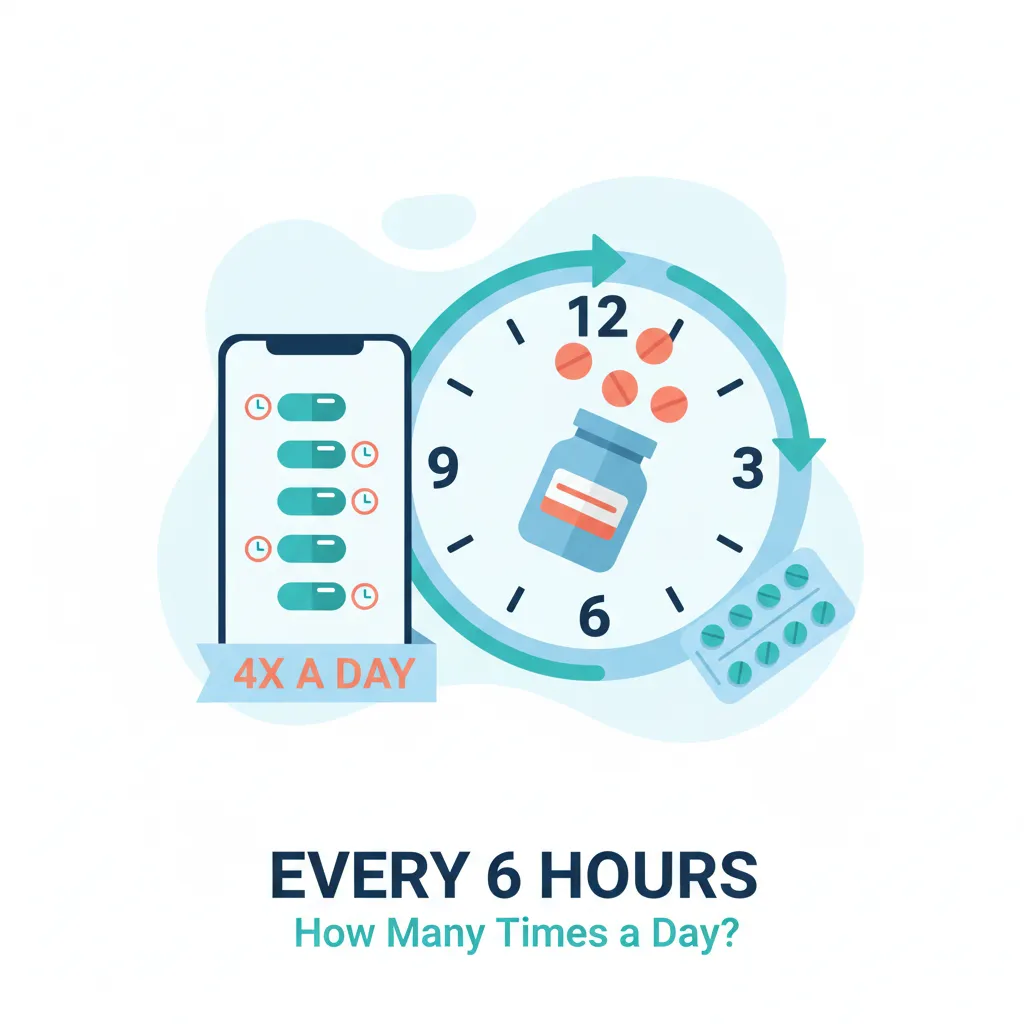
On a prescription, every 6 hours is 4 times a day: that's 4 doses spaced 6 hours apart. A typical schedule is 6 AM, 12 PM, 6 PM, and 12 AM. But "every 6 hours" and "4 times a day" aren't worded the same way. Every 6 hours (Q6H) spells out a 6-hour gap, around the clock. Four times a day (QID) is usually spread across waking hours. Neither wording tells you how exact the gap must be, so ask your pharmacist whether you need a midnight dose.
An every-few-hours routine is easier with a free reminder app that supports interval dosing.
What does Q6H mean? Every 6 hours vs 4 times a day explained
This is the question that fills pharmacy voicemail boxes. Your label says "every 6 hours." Does that mean you need to set an alarm for 3 AM?
Maybe. It depends on the drug and on what your doctor meant.
"Every 6 hours" (Q6H) spells out the gap: four doses about 6 hours apart, around the clock if necessary. The Latin is "quaque sexta hora." You're splitting the full day into four equal 6-hour windows. It is the same number of doses as "four times a day." What neither phrase tells you is how exact you need to be.
Q6H PRN, QID, QHS: decode every prescription abbreviation in one table.
"Four times a day" (QID) tells you how many doses to take, not how exact the gap must be. QID doses are usually taken during waking hours, often tied to meals and bedtime: breakfast, lunch, dinner, and before bed. That leaves an overnight gap longer than 6 hours. Whether that is fine depends on the drug, not the wording.
Here's the comparison:
| Instruction | What it means | Example schedule | Overnight gap | Flexibility |
|---|---|---|---|---|
| Every 6 hours (Q6H) | Four doses about 6 hours apart, around the clock | 6 AM, 12 PM, 6 PM, 12 AM | 6 hours | Depends on the drug. Ask your pharmacist |
| 4 times a day (QID) | Four doses, usually spread across waking hours | 8 AM, 12 PM, 5 PM, 10 PM | ~10 hours | Depends on the drug. Ask your pharmacist |
Hospital rules also go by the drug. ISMP's guidelines for hospitals give most doses taken more than once a day, but no more often than every 4 hours, one goal: "within 1 hour before or after the scheduled time." Their examples include both "TID" and "q6h." Only a limited number of time-critical drugs get 30 minutes or less. Those rules are for hospital staff, not for home.
The math problem: 4 doses x 6 hours = 24 hours. That fills the entire day with no breaks. If you only take doses during your 16 waking hours, you'd need to space them about 5.3 hours apart, which means you're not hitting true 6-hour intervals. This is why Q6H is the hardest common dosing schedule to follow.
If your label says "every 6 hours" and you're unsure whether to wake up at night, call your pharmacist. OTC pain relievers work differently: many of their labels tie each dose to your symptoms and set a limit for 24 hours. The Tylenol Extra Strength label tells adults and children 12 and over to take 2 caplets "every 6 hours while symptoms last" and says "do not take more than 6 caplets in 24 hours, unless directed by a doctor." That's at most 3 doses a day, not 4. For prescription antibiotics, "every 6 hours" may mean doses around the clock.
Every 6 hours medication schedule: your best options
The goal is to space 4 doses as evenly as possible while keeping most (or all) of them during waking hours.
Option 1: The 6-12-6-12 schedule (true Q6H)
- Dose 1: 6:00 AM
- Dose 2: 12:00 PM
- Dose 3: 6:00 PM
- Dose 4: 12:00 AM (midnight)
This is the cleanest Q6H schedule. The midnight dose is late but manageable if you take it right before bed or set an alarm. If you go to bed at 11 PM, you could shift to 5-11-5-11 instead.
Option 2: Waking hours only (QID-style)
- Dose 1: 7:00 AM
- Dose 2: 12:00 PM
- Dose 3: 5:00 PM
- Dose 4: 10:00 PM
The gaps here are 5, 5, 5, and 9 hours. The overnight gap is longer than 6 hours. Whether that works for your drug is a question for your pharmacist, so ask before you switch from true Q6H to this pattern.
Schedule options by wake-up time
| Wake-up | Dose 1 | Dose 2 | Dose 3 | Dose 4 | Bedtime |
|---|---|---|---|---|---|
| 5:00 AM | 5:00 AM | 11:00 AM | 5:00 PM | 11:00 PM | 11:30 PM |
| 6:00 AM | 6:00 AM | 12:00 PM | 6:00 PM | 12:00 AM | 12:30 AM |
| 7:00 AM | 7:00 AM | 1:00 PM | 7:00 PM | 1:00 AM | 1:30 AM |
| 8:00 AM | 8:00 AM | 2:00 PM | 8:00 PM | 2:00 AM | — |
Notice the problem: the later you wake up, the later your fourth dose gets pushed. An 8 AM start puts your last dose at 2 AM. For most people, the 6-12-6-12 or 5-11-5-11 schedule works best.
If your doctor says true Q6H but you can't do a 2 AM dose, ask whether shifting to a slightly uneven schedule (like 6 AM, 12 PM, 6 PM, 11 PM) would be acceptable. Your pharmacist can tell you whether an uneven split works for your drug.
Why every 6 hours medication is the hardest schedule to follow
Once a day? Easy. Twice a day? Manageable. Three times a day or every 8 hours? Tricky but doable. Every 6 hours? That's where adherence drops off.
The reasons:
- Four doses is a lot to remember. Each additional daily dose lowers adherence. Compliance drops from about 79% with once-daily dosing to around 51%80109-0) with four-times-daily dosing.
- The midnight dose problem. True Q6H means one dose falls during sleeping hours for most people. Waking up for medication disrupts sleep, which makes people skip it or stop the medication entirely.
- No natural anchor for dose 2 or 3. Morning and bedtime are easy anchors. The midday and evening doses float in your schedule with no built-in reminder.
How to take medication every 6 hours for pain relief
One of the most common Q6H medications is pain relief, both OTC (ibuprofen, acetaminophen) and prescription. The reason for the 6-hour interval is how the drug works in your body: it starts wearing off after about 4-5 hours, and you want the next dose to kick in before the current one fades. This gets harder when you are running two pain relievers at once, since naproxen sits on an 8 to 12 hour clock instead. We break that down in whether you can take Tylenol and naproxen together.
This is the concept of "staying ahead of the pain" versus "chasing the pain." If you wait until you hurt again before taking the next dose, you'll have a gap where the medication isn't working. By taking prescribed doses on schedule, you maintain a consistent level of pain relief.
For OTC pain medication, the label often ties each dose to your symptoms. The Advil label tells adults and children 12 and over to take 1 tablet "every 4 to 6 hours while symptoms persist" and says "do not exceed 6 tablets in 24 hours, unless directed by a doctor." Follow the limit on your box, and ask your pharmacist if you're not sure whether you need a dose at night. For prescription pain medication, follow your doctor's specific instructions. Cold medicines run on their own clocks too: the NyQuil Cold & Flu label spaces doses every 6 hours, and our guide to taking NyQuil after DayQuil covers how that fits with a daytime dose.
Missed an every 6 hours dose? Here's what to do
With 4 doses per day, missing one is almost inevitable. Here's how to handle it:
| When you remember | What to do | Next dose |
|---|---|---|
| Within 1-2 hours | Take it now | Resume normal schedule |
| 3 hours late | Take it now | Next dose in 6 hours from now |
| 4-5 hours late (next dose is close) | Skip the missed dose | Take the next dose on schedule |
Don't double up. If you miss your noon dose and remember at 5 PM, take one dose now and shift your schedule forward. Don't take two pills to catch up.
For pain medication specifically: if you miss a dose and the pain returns, take the missed dose as soon as you notice. Then wait as long as your label says before the next one (the Tylenol Extra Strength label says "every 6 hours"), and stay under the label's limit for 24 hours.
Can't remember if you already took your last dose? That's a common problem with 4-times-daily schedules. Here's our guide on what to do when you can't remember if you took your medication.
How to manage an every 6 hours medication schedule without forgetting
Four doses is where pill organizers stop being optional. At this frequency, relying on memory alone is a recipe for missed or double doses.
What works:
- Use a 4-compartment daily pill organizer. Label the compartments with your dose times. When the compartment is empty, you took it. When it's full, you didn't.
- Set 4 separate alarms, labeled by dose number. Not just "take your meds" but "Dose 2 of 4 - noon." Knowing which dose you're on prevents confusion.
- Anchor each dose to a daily event. Wake up (dose 1), lunch (dose 2), dinner (dose 3), bedtime routine (dose 4).
- Keep doses accessible at all times. The midday dose requires having medication at work, school, or wherever you are.
If keeping track of 4 daily doses feels overwhelming, Pillo uses persistent alarms for each dose that keep going until you acknowledge them. It tracks your medication history across all 4 doses, so you can check exactly which ones you've taken today. With Q6H timing, knowing whether you took dose 2 at noon or skipped it matters for when to take dose 3.
Related Guides
You might also find these guides helpful: 4 times a day medication schedule.
FAQ
How many times a day is every 6 hours?
Four times a day. Every 6 hours divides the 24-hour day into four equal 6-hour windows. A common schedule is 6 AM, 12 PM, 6 PM, and 12 AM. If your label says "4 times a day" rather than "every 6 hours," the doses are usually spread across waking hours, but ask your pharmacist how exact the spacing must be. OTC boxes can set a lower daily limit: the Tylenol Extra Strength label allows adults and children 12 and over no more than 6 caplets in 24 hours, which is 3 doses of 2 caplets.
Is every 6 hours the same as 4 times a day?
Close to it. On a prescription, both mean four doses in 24 hours. "Every 6 hours" (Q6H) spells out a 6-hour gap, which may include a dose during sleeping hours. "Four times a day" (QID) is usually spread across your waking hours, often tied to meals and bedtime, with a longer overnight gap. The wording does not tell you how exact the gap must be, so ask your pharmacist how strict the timing is for your drug.
What does Q6H mean on a prescription?
Q6H comes from the Latin "quaque sexta hora," meaning "every 6 hours." It tells you to take the medication about 6 hours apart, around the clock if necessary. You'll see it on some antibiotic and pain reliever labels. Q6H names the gap, but neither Q6H nor QID (four times a day) tells you how exact you need to be, so ask your pharmacist how strict the timing is for your drug.
Do I have to wake up at night for every 6 hours medication?
It depends on your specific medication. Many OTC labels for ibuprofen and acetaminophen tie each dose to your symptoms ("while symptoms persist" on the Advil label) and set a limit for 24 hours. For prescription medications, especially antibiotics written as Q6H, you may need to take a dose during the night. Check with your pharmacist if you're unsure.
What happens if I take every 6 hours medication only 3 times a day?
You'll only get three-quarters of your prescribed daily dose, and you'll have a 12-hour gap overnight. For pain medication, this means the pain will return overnight. For antibiotics, the long gap may let drug levels drop below effective concentrations. If you can't manage 4 doses, ask your doctor whether a different medication with less frequent dosing would work.
What does "every 4 to 6 hours" mean on a medication label?
It means you can take the next dose anywhere between 4 and 6 hours after the last one. This range is common on OTC pain relievers and cold medications. Take it closer to every 4 hours if you need stronger coverage, or every 6 hours if the medication is lasting well. Don't exceed the maximum daily doses listed on the label.
If remembering doses is the hard part, a medication reminder app that won't stop until you take your dose can take that job off your plate.
This article is for informational purposes only and does not constitute medical advice. If you're unsure about how to time your medication, ask your doctor or pharmacist. They can give you specific instructions based on your prescription.
Reviewed under our Medical Review Policy.