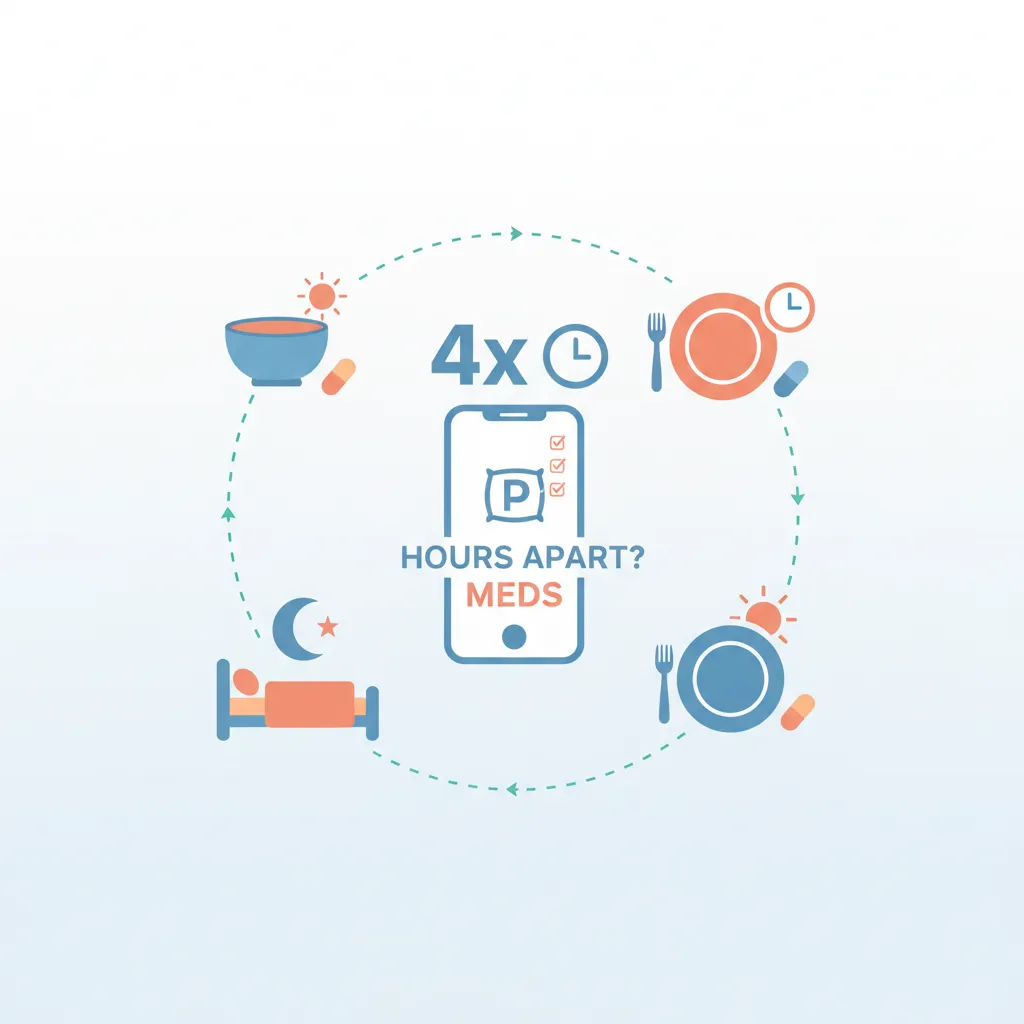
Four times a day usually means 4 doses spread across your waking hours, roughly 4 to 5 hours apart. You usually don't need to wake up at night. A common schedule is 8 AM, 12 PM, 5 PM, and 9 PM. "Every 6 hours" spells out a 6-hour gap, around the clock if necessary. The wording alone does not tell you how exact the gap must be. That depends on the drug, so ask your pharmacist.
For a four-times-daily routine, the best free pill reminder app keeps every dose on time.
4 times a day vs every 6 hours: what your label is really telling you
Your prescription says "four times a day." Not "every 6 hours." Here's what that wording does and doesn't tell you.
Both instructions result in 4 doses per 24 hours. "Every 6 hours" names the gap. "Four times a day" names only the number of doses. On prescriptions, you might see this abbreviated as QID (from the Latin "quater in die," meaning four times a day). Neither wording tells you how exact the spacing must be. That depends on the drug.
QID can be confused with QD, which safety groups flag. See the full abbreviation list.
Here's the difference:
| Instruction | What it means | Example schedule | Overnight gap | Flexibility |
|---|---|---|---|---|
| 4 times a day (QID) | Four doses, usually spread across waking hours | 8 AM, 12 PM, 5 PM, 9 PM | ~11 hours | Depends on the drug. Ask your pharmacist |
| Every 6 hours (Q6H) | Four doses about 6 hours apart, around the clock | 6 AM, 12 PM, 6 PM, 12 AM | 6 hours | Depends on the drug. Ask your pharmacist |
The biggest practical difference: a QID schedule usually lets you sleep through the night. The overnight gap is longer than the daytime gaps. Whether that matters depends on the drug, not the wording. For flucloxacillin, an antibiotic taken 4 times a day in the UK, the NHS says to "Try to space your doses evenly throughout the day." Its example is "first thing in the morning (before breakfast), at around midday (before lunch), late in the afternoon (before your evening meal) and shortly before bedtime."
Hospital rules also go by the drug. ISMP's guidelines for hospitals give most doses taken more than once a day, but no more often than every 4 hours, one goal: "within 1 hour before or after the scheduled time." Their examples include both "TID" and "q6h." Only a limited number of time-critical drugs get 30 minutes or less. Those rules are for hospital staff, not for home.
Every 6 hours names the gap. Q6H spreads doses around the clock, so you may need a midnight or even a 2 AM dose. If your label says "every 6 hours" rather than "four times a day," aim for doses about 6 hours apart, and ask your pharmacist whether you need a night dose.
Not sure how exact you need to be? Look at the exact wording on your label. "Take 4 times daily" = QID. "Take every 6 hours" = Q6H. The wording won't tell you how much leeway your drug allows, but your pharmacist can tell you in 30 seconds.
4 times a day medication schedule: pick your times
The easiest way to remember 4 daily doses: anchor them to meals and bedtime. Unlike every 8 hours or every 6 hours, QID fits naturally into how most people already structure their day.
The meal-plus-bedtime schedule (recommended)
- Dose 1: Breakfast (7-8 AM)
- Dose 2: Lunch (12-1 PM)
- Dose 3: Dinner (5-6 PM)
- Dose 4: Bedtime (9-10 PM)
This is the schedule most pharmacists recommend for QID medications. The gaps between doses range from 4 to 5 hours during the day, with a longer overnight gap of about 10-11 hours. Hospitals use a similar approach, with standard QID times of 9 AM, 1 PM, 5 PM, and 9 PM.
Schedule options by meal timing
| Breakfast | Dose 1 | Dose 2 (Lunch) | Dose 3 (Dinner) | Dose 4 (Bedtime) | Overnight gap |
|---|---|---|---|---|---|
| 6:00 AM | 6:00 AM | 11:00 AM | 5:00 PM | 9:00 PM | 9 hours |
| 7:00 AM | 7:00 AM | 12:00 PM | 5:30 PM | 9:30 PM | 9.5 hours |
| 8:00 AM | 8:00 AM | 12:30 PM | 5:30 PM | 9:30 PM | 10.5 hours |
| 9:00 AM | 9:00 AM | 1:00 PM | 6:00 PM | 10:00 PM | 11 hours |
The gaps between daytime doses in these schedules are not exactly equal. Whether that is close enough depends on the drug, so ask your pharmacist if yours needs evenly spaced doses.
What if your medication needs to be taken with food?
Some QID medications need to be taken with food, which actually makes scheduling easier. The meal schedule above already handles this. If your medication should be taken on an empty stomach, shift each dose 30-60 minutes before meals instead.
Why 4 times a day is actually manageable (if you anchor it right)
Four doses sounds like a lot. And it is. Medication adherence drops from about 79% with once-daily dosing to around 51%80109-0) with four-times-daily dosing. But here's what makes QID easier than you'd expect compared to other 4-dose schedules:
You have 4 built-in anchors. Breakfast, lunch, dinner, and bedtime are events that already happen in your day. You're not trying to remember "2 PM" as an abstract time. You're taking your pill when you sit down to eat. That's a much easier habit to build.
Compare this to every 6 hours, where doses 2 and 3 float in your schedule with no natural anchor points. The noon and 6 PM doses aren't tied to anything memorable. QID doesn't have that problem.
The overnight break makes it easier to stick with. With Q6H, the hardest part is the midnight dose. With QID, you take your last dose before bed and don't think about it again until breakfast. That uninterrupted sleep makes a real difference in whether people stick with their medication.
Missed a 4 times a day dose? Here's what to do
With 4 doses per day, you're going to miss one eventually. How much a late dose matters depends on the drug, not on whether your label says QID or Q6H. If your label or the leaflet that came with your medicine has missed-dose directions, follow those first, and ask your pharmacist if you're unsure. Here's a general pattern:
| When you remember | What to do | Next dose |
|---|---|---|
| Within 1-2 hours of missed dose | Take it now | Resume normal schedule |
| 3 hours late | Take it now | Take next dose at the usual time (if at least 3 hours away) |
| Almost time for next dose | Skip the missed dose | Take the next dose on schedule |
Don't double up. Never take two doses at once to make up for a missed one.
Getting back on schedule: ask your pharmacist whether to pick back up at your next regular time or to shift the rest of the day's doses. The answer depends on the drug, not on whether your label says QID or Q6H.
Can't remember whether you took your last dose? With 4 daily doses, this happens more than you'd think. Here's our guide on what to do when you can't remember if you took your medication.
How to manage a 4 times a day medication schedule without missing doses
The midday doses are where most people slip up. The morning dose happens during your routine, and the bedtime dose is part of winding down. But the lunch and dinner doses? Those get lost in the shuffle.
What works:
- Use a 4-compartment pill organizer. Label compartments with your dose times. An empty compartment means you took it. A full one means you didn't. No guessing.
- Set 4 separate phone alarms. Label each alarm with the dose number: "Dose 2 of 4 - lunch." Just "take your meds" isn't specific enough when you're juggling 4 doses.
- Keep medication where you eat. If your doses are tied to meals, the medication should be on the kitchen table or counter, not in a bathroom cabinet.
- Carry a dose with you. The lunch dose happens at work, at school, or wherever you are. If the medication isn't with you, you'll skip it.
If tracking 4 daily doses with phone alarms isn't cutting it, Pillo uses persistent alarms that keep going until you respond. With 4 doses to track, knowing exactly which ones you've taken and which you haven't saves you from the "did I already take that?" moment at dinner.
FAQ
How many hours apart is 4 times a day for medication?
About 4 to 5 hours apart during waking hours. A typical schedule is 8 AM, 12 PM, 5 PM, and 9 PM. "Four times a day" usually means during your waking hours, so the overnight gap will be longer (around 10-11 hours). Some drugs need evenly spaced doses, so ask your pharmacist how exact yours needs to be.
Is 4 times a day the same as every 6 hours?
Not exactly. Both mean four doses in 24 hours. "Four times a day" (QID) is usually spread across your waking hours. "Every 6 hours" (Q6H) spells out a 6-hour gap, which may include a dose at midnight or later. The wording does not tell you how exact the gap must be. Some drugs taken 4 times a day still need evenly spaced doses, so ask your pharmacist how strict the timing is for yours.
What does QID mean on a prescription?
QID comes from the Latin "quater in die," meaning "four times a day." It tells you to take four doses a day, usually spread across your waking hours, such as with meals and at bedtime. QID tells you how many doses to take, not how exact the gap must be. Ask your pharmacist whether your drug needs evenly spaced doses or a dose at night.
Do I need to wake up at night for 4 times a day medication?
Usually not. Unless your doctor or pharmacist told you to take a dose overnight, "four times a day" doses are usually taken while you are awake, such as with breakfast, lunch, dinner, and before bed. The overnight gap will be longer than the daytime gaps. Some drugs still need evenly spaced doses, so ask your pharmacist whether yours needs a dose at night.
What is a good schedule for taking medication 4 times a day?
A schedule tied to meals works best: breakfast (7-8 AM), lunch (12-1 PM), dinner (5-6 PM), and bedtime (9-10 PM). Hospitals commonly use 9 AM, 1 PM, 5 PM, and 9 PM. Choose times that match your routine and stick with them consistently.
What happens if I only take my 4 times a day medication 3 times?
You'll get three-quarters of your prescribed daily dose, and the drug may not maintain effective levels throughout the day. For some medications this matters more than others. If you regularly struggle with the fourth dose, talk to your doctor. They may be able to switch you to a three-times-daily or twice-daily medication that works just as well.
If remembering doses is the hard part, a free pill reminder app for Android can take that job off your plate.
This article is for informational purposes only and does not constitute medical advice. If you're unsure about how to time your medication, ask your doctor or pharmacist. They can give you specific instructions based on your prescription.
Reviewed under our Medical Review Policy.