This article provides general information about medication management and is not a substitute for professional medical advice. Always consult your doctor or pharmacist before making changes to your medication schedule.
First, do not take your scheduled dose on top of the one you took by mistake, because the main risk of a wrong-time slip is accidentally doubling up. What happens next depends on the type of medication. When in doubt, call your pharmacist or Poison Control at 1-800-222-1222.
Why a wrong-time dose usually is not a crisis
Taking a dose at the wrong time of day is one of the most common medication slips, and for many medications it is manageable. The real concern is rarely the clock. It is whether the off-schedule dose lands close enough to your next planned dose to act like a near-double. According to Poison Control, a double dose of some medicines is minor, while doubling up on others can be serious, and medicines "already being taken at or very near to their maximum dosage have the least room for error."
So the question is not just "I took it at the wrong time." It is "what is this medication, and is my next scheduled dose now too close?" That answer changes a lot depending on what you take. The sections below walk through the common types. None of this replaces a quick call to your pharmacist, who can look at your exact medication and schedule.
What the wrong time tends to do, by medication type
The effect of a wrong-time dose depends on what the medication does and when it is normally taken. Here is how the common types tend to behave.
| Medication type | Wrong-time slip | What it tends to cause | What to watch for |
|---|---|---|---|
| Sleep aids / sedatives | Taken in the morning | Daytime drowsiness that can last hours | Do not drive. Sleepiness, slowed reactions. |
| Stimulants (ADHD medicines) | Taken late in the day | Trouble falling asleep that night | Restlessness, a racing mind at bedtime. |
| Diuretics (water pills) | Taken at night | Extra bathroom trips overnight | Interrupted sleep for the next several hours. |
| Blood pressure, heart, diabetes | Lands near the next dose | Acts like a near-double | Dizziness, faintness, or unusual readings. |
Sleep aids and sedatives are the clearest example of why time of day matters. The FDA has warned that even a normal bedtime dose of some sleep medicines can leave enough drug in the body to impair next-morning activities such as driving, "despite perhaps feeling fully awake." So taking one in the morning can be associated with hours of daytime drowsiness. If this happens, the safest move is to not drive and to let someone know. For two common examples, see what to do if you accidentally took gabapentin in the morning or took diphenhydramine (Benadryl) in the morning.
Stimulants work the other direction. The FDA label for methylphenidate notes that "nervousness and insomnia are the most common adverse reactions but are usually controlled by reducing dosage and omitting the drug in the afternoon or evening." A stimulant taken late is therefore associated with a harder time sleeping that night.
Diuretics, often called water pills, are timed for the morning for a practical reason. StatPearls notes that "patients should take loop diuretics early in the afternoon so the diuretic effect ends before bedtime." Taken at night, a diuretic is associated with more trips to the bathroom and broken sleep, since the effect can last several hours. This plays out differently by drug: see what to do if you took furosemide at night or took bumetanide at night.
Blood pressure, heart, and diabetes medicines are usually more forgiving of a small timing shift on their own. The bigger question is whether the off-schedule dose now sits close to your next planned one. Poison Control specifically names medicines for high blood pressure, ADHD, and diabetes among those where doubling up can be serious, so this is the group where a quick pharmacist call matters most.
What to do right now
- Do not take the matching scheduled dose on top of it. Taking the "correct" dose now, right after the mistaken one, is what turns a timing slip into a true double dose. Hold off and get guidance first. Our guide on a dose taken too close to the last one explains why spacing matters.
- Figure out what type of medication it is. Use the table above. A sleep aid, a stimulant, a diuretic, and a blood pressure pill each call for a different next step.
- Watch for the signs that match your medication. Drowsiness from a sedative, sleeplessness from a stimulant, bathroom trips from a diuretic, or dizziness from a blood pressure medicine.
- If it was a sedative or sleep aid, do not drive. Daytime impairment can be real even when you feel alert. Arrange another way to get around until it wears off.
- Call for guidance when you are unsure. Your pharmacist can check your exact medication and schedule. For a possible overdose or worrying symptoms, call Poison Control at 1-800-222-1222, which is free and open 24 hours. If someone cannot be woken, is struggling to breathe, or is having a seizure, call 911 right away.
For related timing questions, see what happens when a dose is taken a couple of hours off schedule, how late a morning dose can safely slide, and why some medicines are assigned to morning or night in the first place. If your concern is the opposite, accidentally taking two of the same dose, see our guide on a double dose of blood pressure medication. And if you are not even sure whether you already took today's dose, here is how to settle that without guessing.
How Pillo helps you stop the morning and night mix-up
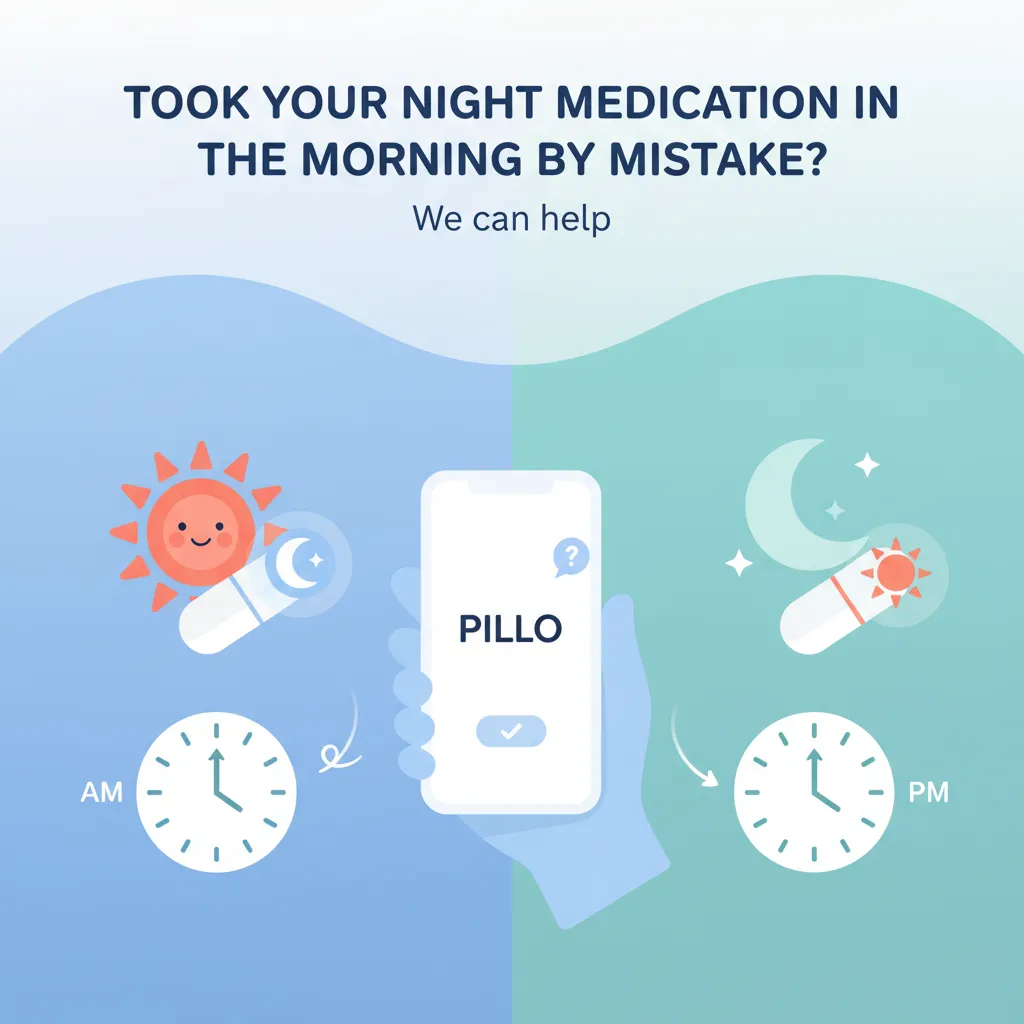
The wrong-time mix-up usually comes from one place: morning and evening pills blur together when they live in the same routine. Pillo lets you set separate, clearly labeled reminders for each time of day, so your morning set and your night set never share an alarm. Its persistent alarm keeps prompting until you actually confirm the right dose, and the simple log records what you acknowledged and when, so you can see at a glance whether the morning dose already happened before you reach for the bottle.
That separation is the point. When each dose has its own labeled, persistent reminder, the "wait, was that the night one?" moment gets a lot rarer. Download Pillo on Google Play. The same routine habits that prevent timing slips also help on the days your schedule slides, like our tips for staying on track on weekends.
Frequently Asked Questions
I took my night medication this morning. Should I skip tonight's dose?
Do not decide this on your own, and do not automatically take tonight's dose on top of the one you already took. Whether to skip, delay, or continue depends entirely on the specific medication. Call your pharmacist for advice specific to your medication, or Poison Control at 1-800-222-1222 if you are worried.
Is it dangerous to take medication at the wrong time of day?
For many medications, a one-time timing slip is manageable, and the main risk is accidentally doubling up if the dose lands close to your next one. Some types matter more than others. A sleep aid taken in the morning can cause daytime drowsiness, and blood pressure, ADHD, or diabetes medicines are ones Poison Control flags as more serious when doubled. When unsure, ask your pharmacist.
I took my morning pills at night by mistake. What now?
The same rules apply in reverse. Do not take the night dose on top of them, and think about what the medicines are. A stimulant taken at night is associated with trouble sleeping, while a once-daily blood pressure pill is often more forgiving. Check with your pharmacist if your next scheduled dose is now close.
Should I call Poison Control or 911?
If the person is awake, breathing normally, and feels okay, Poison Control at 1-800-222-1222 is the right first call, and it is free and confidential. Call 911 instead if someone cannot be woken, is having trouble breathing, or is having a seizure.
How do I stop mixing up my morning and night pills?
Give each time of day its own clearly labeled reminder rather than relying on memory, and use an alarm that keeps prompting until you confirm the correct dose. Keeping morning and evening medications visually and physically separate, and logging each dose as you take it, makes the wrong-time slip much less likely.
If remembering doses is the hard part, the Pillo medication reminder app can take that job off your plate.
This article is for informational purposes only and does not constitute medical advice. Always consult your doctor or pharmacist before making any changes to your medication routine. If you suspect an overdose, call Poison Control at 1-800-222-1222 or 911 for emergencies.