Zoloft and Alcohol: The Short Answer
The FDA label's answer is no. The Medication Guide in the Zoloft label says: "Do not drink alcohol while you take ZOLOFT." A separate section written for prescribers reports that in healthy subjects, Zoloft did not make alcohol's short-term effects on thinking and movement worse. That study finding does not change the instruction. Sertraline and its main metabolite stay in your body for about three weeks, so skipping a dose does not clear it. If you want to drink, talk to your prescriber first.
Medical Disclaimer: This article is for informational purposes only and does not replace professional medical advice. Consult your doctor or pharmacist for advice specific to your medications.
Why This Question Deserves a Real Answer
If you are searching this, you are probably not deciding about spring break. You are more likely someone managing depression or anxiety alongside a blood pressure pill, a statin, a thyroid medication, or maybe all three, trying to figure out whether a glass of wine at dinner or a beer at a wedding is going to set back your treatment.
That is a fair question. The stock answer online is either a flat no with no reason given or a vague shrug, and neither tells you why. The NIAAA Harmful Interactions brochure warns that alcohol can make a medication "less effective or even useless," and lists drowsiness, dizziness, and worse depression for Zoloft. And Cleveland Clinic notes that alcohol "does the opposite of what antidepressants are trying to achieve." So the stakes are real. But so is your right to a clear-eyed answer instead of a lecture.
Here is what is below: the exact FDA quote and what it really means, how long Zoloft stays in your system, what the research shows actually happens when SSRI patients drink, the four Zoloft clinical trials on alcohol use disorder, and what to do if you already drank tonight.
What the FDA Label Actually Says
The Zoloft label talks to patients and to prescribers in different sections. The Medication Guide, the part written for people who take the drug, lists alcohol under what to avoid: "Do not drink alcohol while you take ZOLOFT."
The prescribing information for doctors adds one study finding, in Section 12.2 (Pharmacodynamics): "In healthy subjects, the acute cognitive and psychomotor effects of alcohol were not potentiated by ZOLOFT." In plain terms, in healthy volunteers, Zoloft did not make alcohol's short-term effects on thinking and movement worse. That is a study result, not permission to drink, and the Medication Guide's instruction stands.
A few limits matter. The subjects were healthy volunteers, not patients. The study measured alcohol's acute effects on thinking and movement, not sleep, mood, or months of regular drinking. And Zoloft's own label still warns about serotonin syndrome, QT prolongation, and bleeding risk.
There is one other detail almost nobody mentions. Zoloft oral solution contains 12% alcohol and is contraindicated in anyone taking disulfiram (a drug used to maintain sobriety). The label also says the liquid is not recommended during pregnancy because of its alcohol. If you use the liquid form, that matters.
How Long Does Zoloft Stay in Your System?
This is the question almost every search about Zoloft and alcohol is quietly asking. The answer is longer than you probably think.
Sertraline itself has a plasma half-life of about 26 hours. But sertraline gets broken down into a weakly active metabolite, N-desmethylsertraline, that has a half-life of 62 to 104 hours. As a clinical pharmacokinetics review in Clinical Pharmacokinetics explains, this metabolite actually accumulates to higher blood levels than the parent drug. It takes roughly five half-lives for a drug to clear, which means the full washout is weeks, not days. The table is a rough estimate from the label's half-lives; real levels vary from person to person.
| Time since last Zoloft dose | Sertraline left | Metabolite left |
|---|---|---|
| 24 hours | ~53% | ~77-85% |
| 3 days | ~15% | ~45-62% |
| 5-6 days | ~2-4% | ~20-45% |
| 2 weeks | ~0% | ~2-11% |
| 3 weeks | ~0% | under 4% |
So skipping tonight's Zoloft does not clear it. Skipping three nights does not clear it. Skipping a week still leaves some of the metabolite in your body. Zoloft is designed to be steady and long-acting, and that is part of why it works.
If someone tells you they are "skipping Zoloft for the weekend" to drink safely, they are getting the worst of both worlds. The drug is still in their system, and now their dosing rhythm is broken, which risks discontinuation symptoms and a drift in how well the medication is working.
What Actually Happens When You Drink on Zoloft
Four things show up in the research and the label.
1. You feel drunker than you expected. A 2014 review in the International Journal of Risk and Safety in Medicine analyzed 201 detailed case reports of SSRIs and related antidepressants combined with alcohol. Roughly half described "pathological intoxication," marked by unexpected and often gross disinhibition. Memory loss happened in 53 cases. Some ended in serious violence, including 8 cases of homicide.
2. Your depression or anxiety gets worse. Alcohol is a depressant. A Cleveland Clinic psychiatrist puts it bluntly: alcohol "does the opposite of what antidepressants are trying to achieve." Drinking also suppresses REM sleep, which is tied to mood and memory. If your Zoloft feels like it has stopped working, alcohol is one of the first things to look at before asking for a dose increase.
3. Side effects stack. Cleveland Clinic's sertraline drug page notes that drinking can "increase the risk" of dizziness, impaired coordination, and slower reaction time. For a 55 year old also on a blood pressure pill, that means a real fall risk, not a theoretical one.
4. Serotonin syndrome is a drug-combination risk. Alcohol does not cause it on its own. The Zoloft label warns that the risk goes up when Zoloft is combined with other serotonergic drugs. This is the polypharmacy risk, covered below.
Has Zoloft Actually Been Studied in Drinkers?
Yes. Sertraline has been tested against drinking outcomes in at least four randomized trials. Fluoxetine has trials too, including a 1997 placebo-controlled study in 51 depressed, alcohol-dependent patients that found less drinking on fluoxetine.
The picture is nuanced, not a cheer or a warning.
- A 2000 study in Alcoholism: Clinical and Experimental Research (Pettinati et al., n=100) found that sertraline led to better drinking outcomes than placebo in lower-risk, less severe alcoholics, but not in the higher-risk, more severe group. Which kind of drinker you are changes the answer.
- A 2010 study in the American Journal of Psychiatry (Pettinati et al., n=170) was the landmark. In patients with co-occurring depression and alcohol dependence, sertraline combined with naltrexone produced abstinence rates around 54%, compared to 21 to 28% for either drug alone or placebo. All groups also got weekly CBT over the 14 weeks. Median time to relapse into heavy drinking was 98 days on the combination versus 23 to 29 days on the others.
- A 2003 trial in Alcohol and Alcoholism (Gual et al., n=83) found no overall relapse benefit for sertraline, but patients who started with severe depression did show a significant benefit from sertraline.
- A 2003 trial in the Journal of Clinical Psychopharmacology (Moak et al., n=82) found that sertraline plus CBT reduced drinks per drinking day compared to placebo plus CBT, and female patients saw bigger depression improvements.
Sertraline is not a miracle cure for drinking, and for some drinkers it does very little. But if you have comorbid depression and drinking that you want to reduce, sertraline has real evidence behind it, especially when paired with naltrexone and a therapist. This is a conversation worth having with your prescriber, not something to DIY.
The Polypharmacy Risk Most Articles Skip
If you are over 50 and on more than one medication, this is the section that matters most.
Zoloft raises serotonin. Several other common medications and supplements raise serotonin too, and stacking them raises the odds of serotonin syndrome.
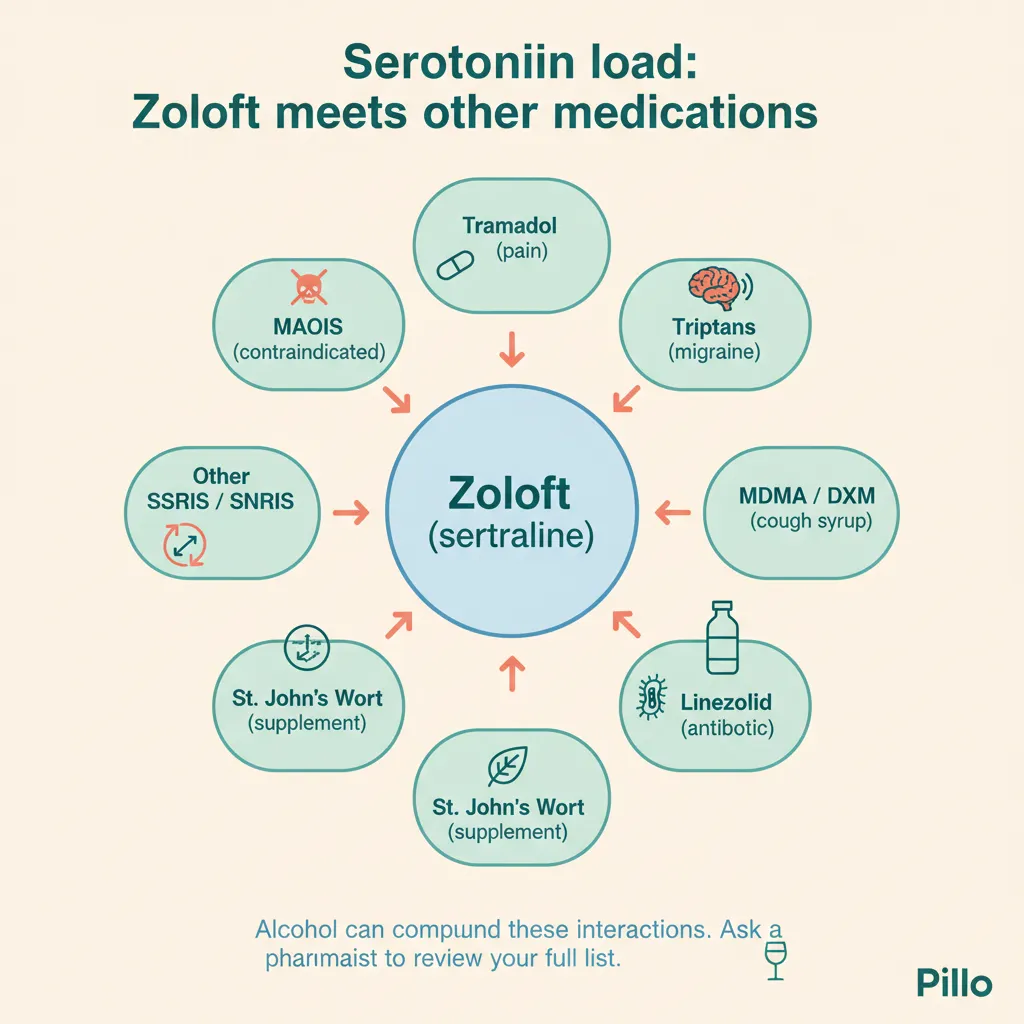
Before you make a decision about drinking, ask your pharmacist to review your full medication list, including supplements like St. John's Wort and 5-HTP. Reported SSRI-alcohol problems are often behavioral, like unexpected disinhibition and memory loss, which makes them easy to miss until the damage is done.
If You Already Drank Tonight
If you are reading this after the fact, don't panic, but pay attention to how you feel. Here is what to do.
- Do not take an extra Zoloft dose to "balance" anything. There is nothing to balance.
- Do not skip tomorrow's dose either. Stay on your normal schedule.
- Eat, hydrate, and go to bed safely. If you drove, arrange a ride home.
- Watch for symptoms that are not normal hangover territory: severe confusion, muscle twitching or stiffness, a pounding heartbeat, high fever, agitation that feels outside yourself. These can be signs of serotonin syndrome and are a reason to call 911 or your local emergency number. The label tells doctors to stop Zoloft and other serotonergic drugs right away if these symptoms occur.
- If you find yourself drinking more than you meant to on Zoloft, repeatedly, that is worth raising with your prescriber. Stopping Zoloft on your own is rarely the right move. See our medication and alcohol: how long to wait guide for a general framework, and our Lexapro and alcohol pillar if you are comparing SSRIs.
The Two Quieter Risks for the 40 to 65 Reader
QT prolongation. The FDA label lists QTc prolongation as a warning, and the effect rises with sertraline blood levels. Alcohol, especially heavier drinking, adds its own arrhythmia risk. For anyone with an existing heart condition or on a QT-prolonging medication (certain antibiotics, antifungals, antipsychotics), this is a pharmacist conversation.
Falls. Zoloft can cause dizziness. Alcohol causes dizziness. A blood pressure medication can cause orthostatic hypotension. Three layers of the same effect compound, especially getting up at night.
Why Adherence Quietly Slips Around Alcohol
There is a reason clinicians worry about alcohol on Zoloft that rarely makes the headlines: it breaks your dosing routine.
Two common patterns we see:
- "I am drinking tonight so I should skip my Zoloft." You do this three weekends in a row and your blood levels drift. Discontinuation symptoms creep in. The drug starts to feel unreliable.
- "I do not remember if I took it, so I will take one to be safe." The Medication Guide says not to take two doses at the same time, and to call your healthcare provider or poison control center right away, or go to the nearest emergency room, if you take too much. A double dose often points to a missing reminder system.
Consistency is underrated on SSRIs. They work through steady-state dosing. Breaking the rhythm is often what turns a working medication into one that feels like it has stopped working.
How Pillo Helps
Pillo is a medication reminder app built for people who take more than one medication and need help staying consistent. The persistent alarm does not stop until you confirm the dose, which removes the "did I take it?" guessing that often leads to doubling or skipping on nights out.
If alcohol is part of your life and you take Zoloft, the single most useful thing you can do is keep your dosing boring and separate from your drinking decisions. Pillo lets you set a consistent reminder time so your dose happens whether it is a Tuesday at home or a Saturday at a wedding. The confirmation log gives you a clear answer to "did I take it yet?" on nights when your memory is less sharp than usual. Download Pillo on Google Play. Free, Android only.
Frequently Asked Questions
Can I drink on Zoloft if I only have one glass of wine?
The Zoloft Medication Guide says: "Do not drink alcohol while you take ZOLOFT." That is the label's answer for one glass too. In a study of healthy volunteers, Zoloft did not worsen alcohol's short-term effects on thinking and movement, but real-world responses vary, and some people feel significantly more impaired than they expected. If a glass of wine with dinner matters to you, ask your prescriber or pharmacist before you have it, especially if you take another serotonergic medication. Never drive after drinking.
How long after taking Zoloft can I drink alcohol?
There is no clean waiting window. Sertraline has a 26 hour half-life, and its main metabolite has a 62 to 104 hour half-life, so the drug and its metabolite take about three weeks to mostly clear after your last dose. You cannot time a drink around a dose. Since the label tells patients not to drink while taking Zoloft, the question to bring to your prescriber is whether any alcohol is OK for you.
Can I skip Zoloft for a weekend so I can drink safely?
No. Skipping doses does not clear Zoloft fast enough to matter and risks discontinuation symptoms plus a dip in how well the drug is working. You end up with the medication still in your system and a broken schedule. If drinking is genuinely important to you, bring it to your prescriber, not to a DIY dose skip.
Does alcohol stop Zoloft from working?
Alcohol can reduce Zoloft's effectiveness in two ways. First, alcohol is a depressant and can directly worsen depression symptoms. Second, Cleveland Clinic notes that alcohol disrupts the REM sleep your mood depends on and can interfere with how antidepressants work. If Zoloft is not working as well as it used to, alcohol is one variable worth examining when you talk to your prescriber.
Is Zoloft prescribed for people who drink too much?
Sometimes, yes. Sertraline has a real research record in alcohol use disorder. A 2010 American Journal of Psychiatry trial found that sertraline combined with naltrexone produced better abstinence rates than either drug alone in patients with comorbid depression and alcohol dependence. The evidence is mixed across trials, and subtype of drinker matters, so this is a specialist conversation, not a self-prescribed use.
Is it dangerous to drink on Zoloft if I take a blood pressure medication?
Combining Zoloft, alcohol, and a blood pressure medication raises fall risk: Zoloft and alcohol can both cause dizziness and affect coordination, and a blood pressure medication can make you light-headed when you stand up. The label's no-alcohol instruction already applies here, and the extra fall risk is one more reason to follow it. If you are thinking about drinking anyway, talk to your prescriber first, stand up slowly, and do not drink alone.
This article provides general information about medication management and is not a substitute for professional medical advice. Always consult your doctor or pharmacist before making changes to your medication schedule.
Reviewed under our Medical Review Policy.