Lexapro and Alcohol: The Short Answer
The FDA label's answer is no. The Medication Guide in the Lexapro label says: "Do not drink alcohol during treatment with Lexapro." The prescribing information for doctors also says alcohol use by patients taking Lexapro is not recommended. Because Lexapro stays in your body for about 6 to 7 days after a dose, skipping tonight's pill will not make it safe to drink. If you already drank, do not panic. If you want to drink, talk to your prescriber first.
Medical Disclaimer: This article is for informational purposes only and does not replace professional medical advice. Consult your doctor or pharmacist for advice specific to your medications.
Why This Question Deserves a Real Answer
If you are searching for this, you are probably not a college student wondering about a party. You are more likely someone managing anxiety or depression alongside a blood pressure pill, a statin, a thyroid medication, or maybe all three, and you want to know whether a glass of wine at dinner is going to cause a problem.
That is a fair question. And the standard internet answer, which is either a flat no with no reason given or a shrug, does not explain why. The NIAAA lists antidepressants among the medicines that interact with alcohol, and its guide for clinicians notes that even low levels of drinking may reduce how well an antidepressant works and lower adherence. So the stakes are real. But so is your right to an informed answer.
What the FDA Label Actually Says About Lexapro and Alcohol
The prescribing information for Lexapro, updated for escitalopram since the drug's initial U.S. approval in 2002, contains an interesting nuance most summaries leave out. In Section 12.3 (Drug Interaction Studies), the label notes that "Lexapro did not potentiate the cognitive and motor effects of alcohol in a clinical trial." In other words, in a controlled study, Lexapro alone did not make people more impaired by alcohol than alcohol alone would.
And yet, the very next sentence says "the use of alcohol by patients taking Lexapro is not recommended." The label's advice on what doctors should tell patients goes further: "the concomitant use of Lexapro and alcohol in depressed patients is not advised." And the Medication Guide, the part of the label written for people who take Lexapro, says it plainly: "Do not drink alcohol during treatment with Lexapro."
So why the gap between the trial and the label's guidance? The label says that finding comes from experiments with "normal subjects," meaning healthy volunteers in a controlled setting. That is not the reality for most people on Lexapro. And the risks of mixing alcohol with any SSRI, worse depression, a weaker response to the drug, amplified sedation, do not require a change in how the drug is metabolized to cause harm.
How Long Does Lexapro Stay in Your System?
This is the question almost every search about Lexapro and alcohol secretly wants answered. Here is the math.
The half-life of escitalopram is approximately 27 to 32 hours. Half-life is the time it takes for half of the drug in your bloodstream to clear. After about five half-lives, roughly 97% of a drug is gone. So Lexapro stays in your body for roughly 6 to 7 days after your last dose, and longer if you are 65 or older: the label says the half-life runs about 50% longer at that age.
| Time since last Lexapro dose | Roughly how much is still in your system |
|---|---|
| 24 hours | ~54-59% |
| 48 hours | ~29-35% |
| 72 hours | ~16-21% |
| 5 days | ~5-7% |
| 7+ days | ~3% or less |
So skipping a dose before a night out will not clear Lexapro. For why skipping to drink backfires and what the label says instead, see can I skip a dose of Lexapro to drink?
What Can Actually Happen When You Drink Alcohol on Lexapro
Here is what research has documented.
1. You feel drunker than you expected. A 2014 analysis in the International Journal of Risk and Safety in Medicine reviewed 201 case reports of antidepressant and alcohol interactions. Roughly half of detailed cases described "pathological intoxication," meaning unexpected and often extreme disinhibition after drinking. Memory loss was prominent in just over half of those cases (53 of 100). The authors called for warnings to alert prescribers and patients to this risk.
2. Your depression or anxiety gets worse. Mayo Clinic notes that alcohol can make symptoms of depression and anxiety worse and can stop the benefits of your antidepressant. If your Lexapro feels like it is not working as well as it used to, alcohol is one of the first things to look at before asking for a dose increase.
3. Side effects amplify. Cleveland Clinic lists dizziness, impaired coordination, slowed reaction time, and impaired judgment as Lexapro side effects that alcohol can make more likely. For a 55-year-old already on a blood pressure medication, that can add to fall risk.
4. Serotonin syndrome has been reported. A 2019 case report in Clinical Neuropharmacology described a patient on Lexapro and clomipramine who developed full serotonin syndrome, including tremor, rapid heart rate, and confusion, after drinking beer. The authors concluded that alcohol and antidepressants may interact to cause it.
The Polypharmacy Risk Most Articles Miss
Lexapro raises serotonin. Other medications you might be taking can raise serotonin too. The Lexapro label says the risk of serotonin syndrome goes up when it is taken with other serotonergic drugs, including other SSRIs, triptans, tramadol, lithium, and St. John's Wort. MAOIs, including the antibiotic linezolid, are off-limits: the Medication Guide says not to take Lexapro with one or within 14 days of stopping one.
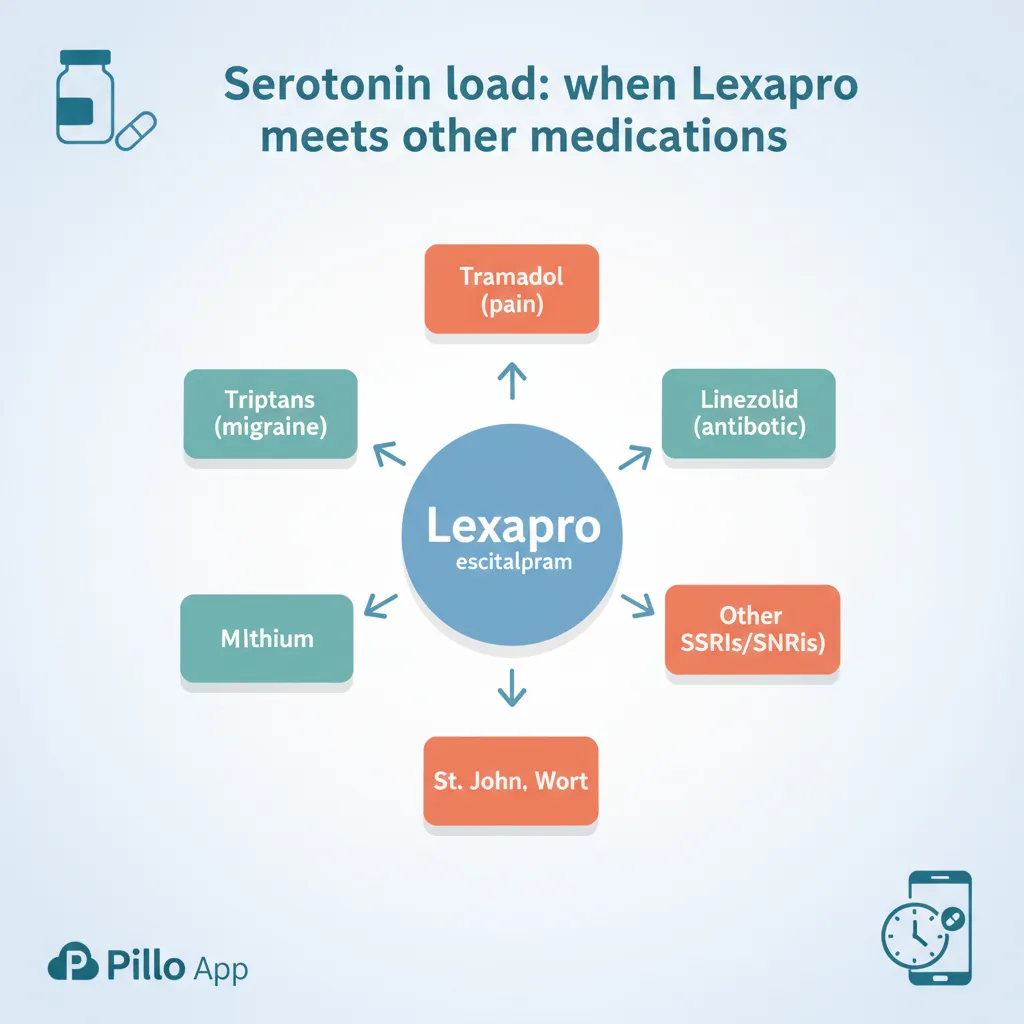
Ask your pharmacist to review your full list, including supplements, before making any calls about alcohol. The NIAAA clinician resource notes that alcohol may increase the effects of antidepressants on the central nervous system, such as drowsiness and dizziness.
If You Already Drank Tonight
If you are reading this after the fact, don't panic, but pay attention to how you feel. Here is what to do.
- Do not take an extra Lexapro dose to "make up for" anything. There is nothing to make up for.
- Do not skip tomorrow's dose either. Stay on your normal schedule.
- Hydrate, eat, and go to bed safely. If you drove, arrange a ride home.
- Watch for signs of serotonin syndrome, such as confusion, agitation, muscle twitching or stiff muscles, a fast heartbeat, or high body temperature. The Medication Guide says to call your healthcare provider or go to the nearest hospital emergency room right away if they appear, and the label tells doctors to stop Lexapro and other serotonin drugs immediately if these symptoms occur. Call 911 if it feels like an emergency.
- If you notice a pattern of drinking more than you meant to while on Lexapro, that is worth a conversation with your prescriber, not a reason to stop the medication on your own. See our guide on medication and alcohol: how long to wait for a general framework.
How Much Alcohol Is Too Much on Lexapro?
The FDA label answers this one directly. Its Medication Guide says "Do not drink alcohol during treatment with Lexapro."
If you are weighing a drink anyway, talk to your prescriber or pharmacist about your specific situation first. A few honest points for that conversation:
- If you drank moderately before Lexapro, tell your prescriber how much and how often, and ask whether any alcohol is OK for you. Do not assume your old limit still applies.
- If you have a history of heavy drinking or alcohol use disorder, say so. MedlinePlus asks people taking escitalopram to tell their doctor if they drink or have ever drunk large amounts of alcohol.
- If you are over 65, on more than two medications, or have any liver issue, talk to your pharmacist before any drinking. A 2023 study in European Archives of Psychiatry and Clinical Neuroscience found that liver dysfunction, not alcohol use disorder by itself, was what changed escitalopram blood levels significantly.
Why Adherence Quietly Falls Apart Around Alcohol
There is a less-discussed reason doctors worry about alcohol and Lexapro: it breaks your medication routine.
Two ways this happens:
- "I am drinking tonight so I will skip my Lexapro." Do this every weekend and you are stopping and starting your antidepressant. Mayo Clinic warns that this can make depression worse and could cause symptoms of stopping the drug.
- "I do not remember if I took it, so I will take one to be sure." A double dose of 20 mg is twice the label's 20 mg daily maximum. If you take too much, the Medication Guide says to call your healthcare provider or Poison Help Line at 1-800-222-1222, or go to the nearest hospital emergency room right away.
Consistency is underrated. Antidepressants need regular doses to keep a constant level in your system, and breaking the rhythm can make a manageable medication feel unreliable.
How Pillo Helps
Pillo is a medication reminder app built for people who take more than one medication and need help staying consistent. The persistent alarm does not stop until you confirm the dose, which is how Pillo removes the "did I take it?" guessing that often leads to doubling or skipping.
If alcohol is part of your life and you take Lexapro, the most useful thing you can do is keep your dosing boring and regular, separate from your drinking decisions. Pillo lets you set a consistent reminder time so your dose happens whether it is a Tuesday at home or a Saturday at a wedding. The confirmation log also gives you a clear answer to the "did I take it yet?" question on nights when your memory is less sharp than usual. Download Pillo on Google Play. Free, Android only.
Frequently Asked Questions
Can I drink on Lexapro if I only have one glass of wine?
The Lexapro Medication Guide says: "Do not drink alcohol during treatment with Lexapro." That is the label's answer for one glass too. Responses vary widely, and some people feel significantly more impaired than they expected. If a glass of wine with dinner matters to you, ask your prescriber or pharmacist before you have it, especially if you take another serotonergic medication. Never drive after drinking.
How long after taking Lexapro can I drink alcohol?
There is no clean waiting window because Lexapro has a half-life of 27 to 32 hours and stays in your system for about 6 to 7 days after a single dose, longer if you are 65 or older. You cannot "time" a drink around your Lexapro dose. Since the label tells patients not to drink during treatment, the question to bring to your prescriber is whether any alcohol is OK for you.
Does alcohol stop Lexapro from working?
Alcohol can reduce how well Lexapro works in two ways. First, alcohol is a depressant and can worsen depression symptoms directly. Second, Mayo Clinic notes that alcohol can stop the benefits of your antidepressant medicine, making your symptoms harder to treat.
Is Lexapro and alcohol dangerous?
Lexapro's label tells you not to drink while you take it. The problems reported with the combination include feeling drunker than expected, worse depression, impaired coordination, and, in one case report of a man on two serotonin drugs, serotonin syndrome. Anyone over 65, on multiple medications, or with liver issues should get a pharmacist review before drinking.
Can I drink if I am on Lexapro and blood pressure medication?
The NIAAA lists dizziness and fainting when alcohol meets blood pressure medicine, and warns that alcohol with some medicines can lead to falls, especially in older people. Alcohol may also add to antidepressant side effects like dizziness. The label's no-alcohol instruction already applies here, and the extra fall risk is one more reason to follow it. If you are thinking about drinking anyway, talk to your prescriber first, stand up slowly, and do not drink alone.
This article provides general information about medication management and is not a substitute for professional medical advice. Always consult your doctor or pharmacist before making changes to your medication schedule.
Reviewed under our Medical Review Policy.