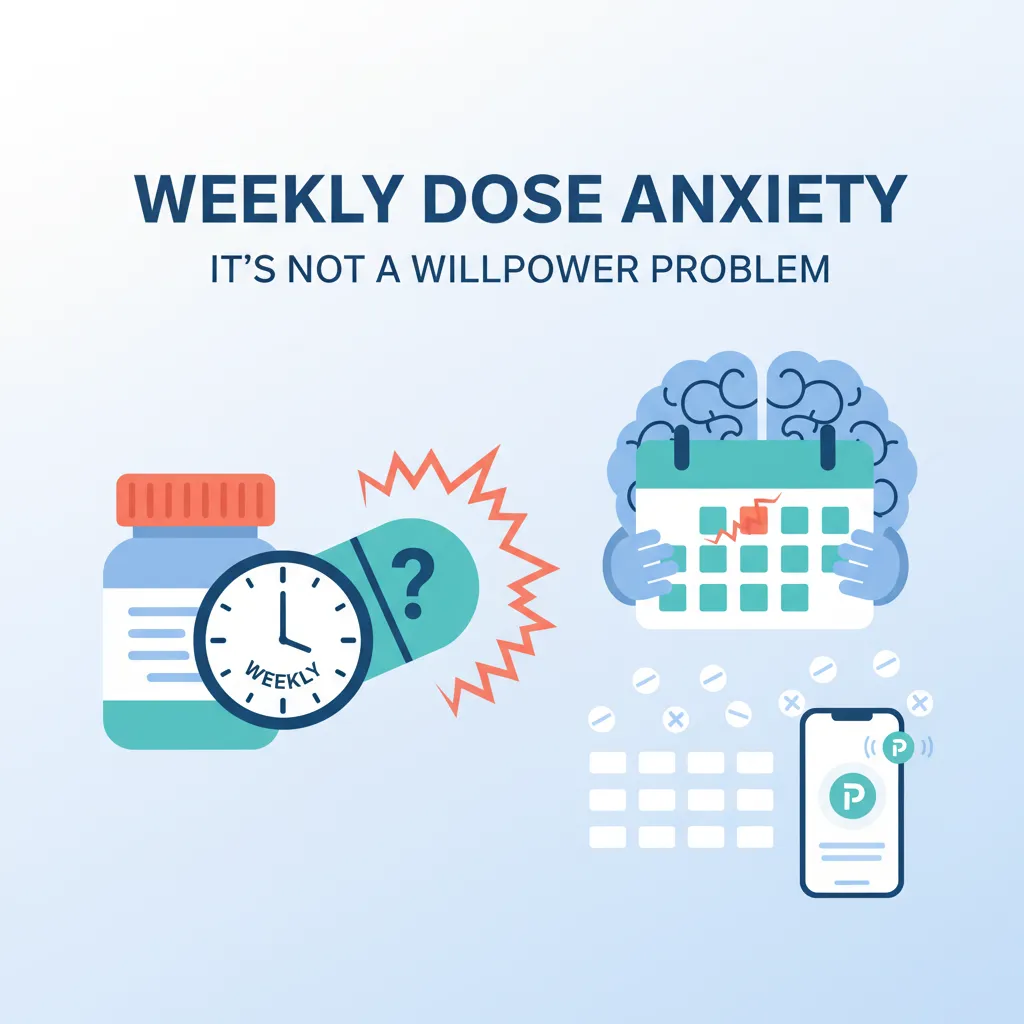
Weekly GLP-1 dose anxiety is not a willpower problem. The widely cited "66 days to form a habit" research (Lally et al., 2010) only studied daily behaviors. Weekly injections like Ozempic, Mounjaro, and Wegovy have no equivalent automaticity data, so the mental load you feel is structural, not personal.
It's Wednesday night. Did you take Sunday's dose?
You're standing at the fridge. The Mounjaro pen is in your hand. Sunday was injection day. You took it. Probably. You think.
You open the phone calendar app. You close it without confirming. You open it again.
Most people on a weekly GLP-1 tell themselves the same thing afterward: "I just need to remember better." That voice is wrong, and the rest of this article is why. The cognitive task you've been handed has barely been studied. The shame doesn't fit the situation. We've covered the broader neuroscience of forgetting pills elsewhere; here, we focus on what's specifically broken about applying daily-habit thinking to a weekly injection.
Your brain isn't built for weekly habits
You've probably heard "it takes 66 days to form a habit." That number comes from a real study: Lally and colleagues at University College London, 2010. What gets left out of every popular retelling is the design of the study.
Volunteers chose one daily behavior. Eat fruit. Go for a walk. Drink water after breakfast. They tracked it every single day for 12 weeks. The 66-day median assumes a daily cue, a daily response, in a stable context. From the open-access Gardner, Lally, and Wardle 2012 companion paper: "automaticity plateaued on average around 66 days after the first daily performance."
Daily. Not weekly.
The largest review of the literature since, Singh et al., 2024, looked at 20 studies and 2,601 participants. The studies are dominated by daily behaviors: water, vitamins, flossing, physical activity. No subgroup examines weekly cadence. Across the whole field, there is essentially no longitudinal evidence that weekly behaviors form automatic habits the way daily ones do.
Wood and Neal, 2007, foundational habit research in Psychological Review, explains why. Habits form when your brain learns associations between contexts that "have historically covaried" with a response. Daily meds piggyback on your morning routine: coffee, brushing teeth, getting dressed. The context fires the cue. The cue fires the action.
Weekly meds don't have that scaffolding. Sunday morning a week from now might be at home, at a hotel, at brunch, or recovering from a poor night's sleep. The context is never the same twice. This is what researchers describe as "orphan behavior," and it's a fundamentally different cognitive task than building a daily habit.
The FDA can't even agree how to describe a missed dose
If the brain side weren't already hard enough, the regulatory side adds a translation tax.
Pull up the FDA prescribing information for the five most common weekly GLP-1s. Each one has a "missed dose" section. Two of them describe the rule one way. Three describe it another.
| Drug | Take if missed within | Skip if after | Framing convention |
|---|---|---|---|
| Ozempic (semaglutide) | 5 days after missed dose | More than 5 days | Days since missed |
| Mounjaro (tirzepatide) | 4 days (96 hours) after missed dose | More than 4 days | Days since missed |
| Zepbound (tirzepatide) | 4 days (96 hours) after missed dose | More than 4 days | Days since missed |
| Wegovy (semaglutide) | Next dose more than 2 days away | Next dose less than 2 days away | Days until next |
| Trulicity (dulaglutide) | 3+ days (72+ hours) until next dose | Less than 3 days until next | Days until next |
Notice the inconsistency. Ozempic, Mounjaro, and Zepbound count days since the missed dose. Wegovy and Trulicity count days until the next scheduled dose. These say the same thing in opposite directions.
For Wegovy, "next dose more than 2 days away" is mathematically equivalent to "missed dose was less than 5 days ago" in a 7-day cycle. But you have to do that math yourself, in your head, mid-week, while half distracted. No wonder the anxiety feels structural.
This is also why patient-education sites sometimes contradict each other. They're translating between conventions, occasionally incorrectly. Always check the current FDA label and talk to your pharmacist.
The 4 anxiety moments nobody talks about
For weekly injections, the anxiety doesn't hit randomly. It clusters in four predictable moments:
- Sunday prep. You're getting the pen ready. Did you swap to a new pen at the right week? Is the dose dial on the right setting from last titration?
- Mid-week doubt. You're 3 to 4 days out from injection day. The signal is fuzziest here. You can't remember if Sunday morning's quick injection actually happened or if you just thought about doing it.
- Refill week. You've finished one pen. The pharmacy refill timing doesn't line up cleanly with your weekly schedule. Now you're tracking pens AND days.
- Travel disruption. Airport security, time zone shift, hotel fridge questions. Weekly cues depend on context. Travel destroys context.
Each of these maps onto a known missed-dose risk window for GLP-1s. The pattern isn't accidental. It's the structural cost of running a non-daily medication on a brain that builds memory through daily repetition.
Why your phone alarm makes this worse
Phone alarms were built for daily habits. Set 9 PM repeat daily, snooze if needed, eventually the routine sticks.
For weekly meds, the same alarm logic creates four failure modes:
- No dose log. When you dismiss the alarm, the phone doesn't record whether the action happened. You can dismiss in the car. You can dismiss while making breakfast. The phone's job is finished. Yours isn't.
- No second chance. The alarm fires once on Sunday. If you snooze and the day fills up, there's no Sunday-night backup ping.
- No verification. There's no way to look back later and confirm you actually injected, versus dismissed-the-alarm-and-meant-to-inject.
- No cadence awareness. A basic alarm treats weekly the same as daily, missing that weekly orphan behaviors need much more reinforcement to land.
Verplanken and Wood, 2006 found that interventions targeting "beliefs and intentions" (basically, willpower) don't work for behaviors that resist habit formation. What does work is "disrupting the environmental factors that automatically cue habit performance." In plain English: external scaffolding, not internal effort.
A phone alarm is the bare minimum of external scaffolding. For weekly injection cadence, it's the wrong tool for the job.
What an actual external scaffold looks like
The kind of system weekly meds need has three things a basic alarm doesn't:
A persistent alarm. The reminder won't dismiss itself. You either log the dose or you keep getting nudged. Not a snooze you can ignore. A system that holds the line until you respond. Pillo was designed around exactly this principle.
A visible dose log. The mid-week "did I?" question gets answered in five seconds: open the app, check Sunday. Either it's logged or it isn't. The uncertainty loop closes.
Built-in escalation for weekly cadence. Sunday morning you dismiss the alarm because you're in line at brunch. The system reminds you again Sunday afternoon. And Sunday night. Until logged.
Download Pillo on Google Play. It's free, Android, designed for people whose meds matter too much to leave to memory or basic alarms.
For more on the underlying principle, our piece on building a medication routine that actually sticks covers daily-habit science; we've also analyzed 60,000 Pillo users' reminder behavior on non-routine days for real-data context. For drug-specific guidance: missed Ozempic dose, the Mounjaro 4-day rule, and Wegovy missed-dose timing. If you can't remember whether Sunday happened at all, see our forensic checklist for Mounjaro day verification.
FAQ
Is the 66-day habit rule true for weekly medications?
Probably not. The 66-day median comes from Lally et al., 2010, where 96 volunteers tracked a single daily behavior for 12 weeks. The 18-to-254-day range and 66-day median apply to daily cadence with a stable cue. No equivalent longitudinal study exists for weekly behaviors. The honest answer is that habit science can't tell you when weekly meds will feel automatic, because the research isn't there.
Why is weekly medication harder to remember than daily?
Daily meds attach to existing daily routines (coffee, brushing teeth, getting dressed). Weekly meds have no daily anchor. According to Wood and Neal's 2007 review in Psychological Review, habits depend on context cues that "have historically covaried" with the response. Sunday morning is not a constant context: travel, sleep, schedules vary week to week.
What is the missed-dose window for Ozempic vs Mounjaro vs Wegovy?
According to the Ozempic FDA label, take if missed within 5 days, otherwise skip. The Mounjaro FDA label says 4 days (96 hours), otherwise skip. The Wegovy FDA label frames it differently: take if next scheduled dose is more than 2 days away, otherwise skip. These say similar things in different framings. Always check the current label and consult your prescriber.
Should I switch my GLP-1 injection day permanently?
Yes, if it makes the weekly cue more reliable. The Mounjaro FDA label explicitly allows changing the day "as long as the time between two doses is at least 3 days (72 hours)." Picking a day with consistent context (always at home, never traveling) helps far more than picking a popular day. Talk to your prescriber before you switch.
How is Pillo different from my phone's alarm?
A phone alarm fires once and dismisses with a tap. There's no log of whether you actually did the thing. Pillo's persistent alarm keeps reminding you until you log the dose, and the log itself answers the "did I take it?" question whenever it comes up mid-week. For weekly cadence specifically, that combination removes the uncertainty loop a basic alarm can't address.
What if I missed my dose because I traveled?
GLP-1 missed-dose windows apply regardless of why you missed. If you're within the window, inject as soon as you can. If you're outside, skip and resume on your regular day. Always cross-check with the current FDA prescribing information for your specific drug and call your prescriber if you're unsure.
This article provides general information about medication management and is not a substitute for professional medical advice. Always consult your doctor or pharmacist before making changes to your medication schedule.