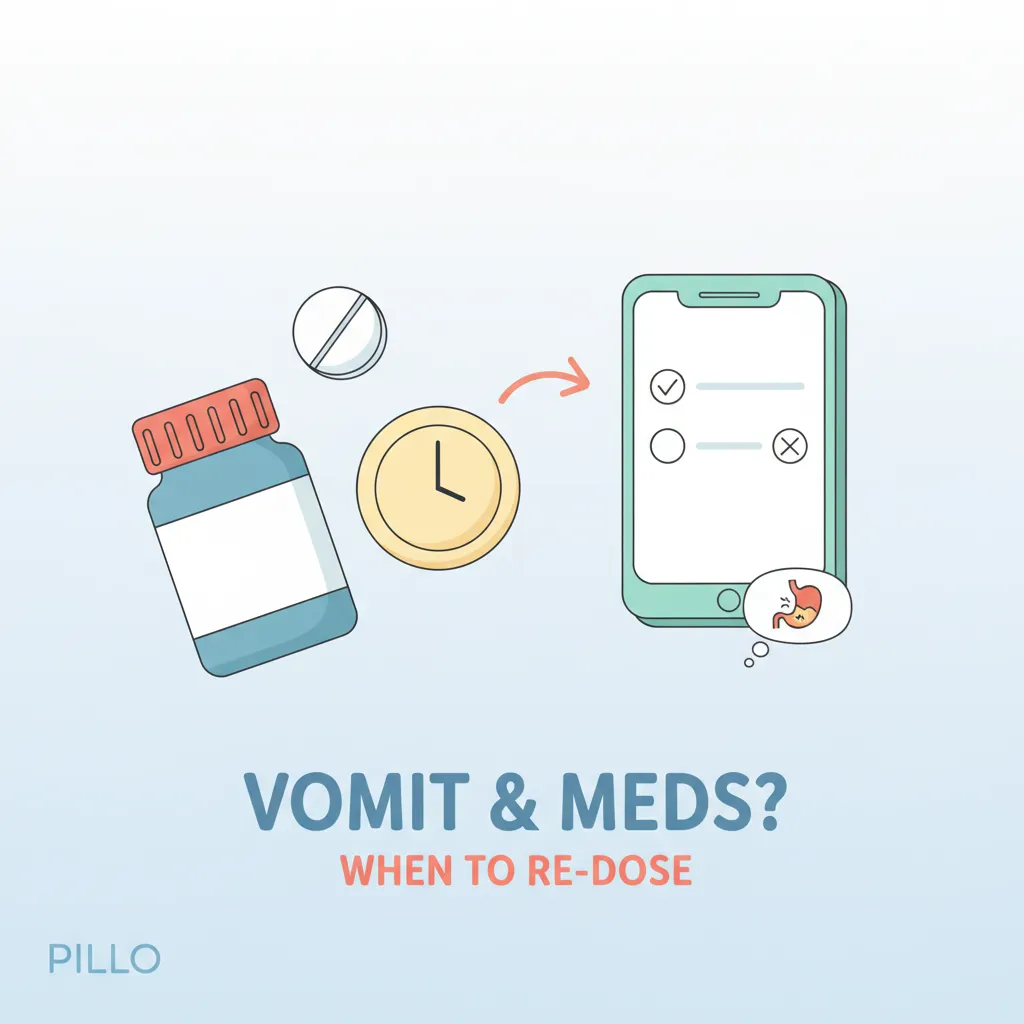
If you threw up shortly after taking a pill, check the timing. Vomited within 15 minutes and can see the pill? It is usually safe to re-dose. More than 60 minutes passed? Your body likely absorbed the drug already, so skip the extra dose. Between 15 and 60 minutes, the answer depends on your medication type.
Always consult your doctor or pharmacist before re-taking any medication after vomiting.
Why Vomiting After Taking a Pill Is So Confusing
You just took your medication and threw up. Now you are wondering: did my body actually get the medicine? Should I take another dose? Could I accidentally double up?
This confusion is more common than you would think. A 2012 survey in the Canadian Journal of Hospital Pharmacy found that only 30% of pediatric hospitals surveyed had formal guidelines for re-dosing after vomiting. Even in clinical settings, providers often rely on judgment calls rather than written protocols.
Most pharmacists follow a straightforward timing framework. While no single rule covers every medication, the breakdown below will help you figure out your next step.
The 15/30/60-Minute Timing Rule for Re-Dosing After Vomiting
Most clinicians decide whether to re-dose based on how much time passed between swallowing the pill and throwing up. According to Kendrick et al. (2012), 60% of hospital practitioners follow a 30-minute rule, while 32% use a 15-minute cutoff.
Here is how it breaks down:
| Time Since Taking Pill | What Likely Happened | General Action |
|---|---|---|
| Under 15 minutes (for example, 5 or 10 minutes) | Pill barely dissolved | Re-dose (most medications) |
| 15 to 30 minutes | Partial absorption | Check your medication type below |
| 30 to 60 minutes (for example, 45 minutes) | Mostly absorbed | Usually do not re-dose |
| Over 60 minutes | Fully absorbed | Do not re-dose |
Key visual check: If you can see the intact pill or capsule in your vomit at any point, the medication was not absorbed. In that case, it is generally safe to take another dose, unless you take a blood thinner, seizure medication, stimulant, or other high-risk drug. For those, call your doctor or pharmacist first, even if you can see the pill.
A 2025 pediatric review by Garnemark et al. confirms that time alone is not enough. Your medication type, medical condition, and what you observe in the vomit all factor into the decision. That is why the medication-specific guidance below matters.
How Your Body Absorbs a Pill
Understanding absorption helps this make more sense.
Standard tablets and capsules dissolve in your stomach within minutes, but dissolving is not the same as absorbing. Actual absorption mostly happens in your small intestine, not your stomach. Even after a pill dissolves, it still needs to travel from your stomach into your intestine before your body gets the full benefit.
This is why vomiting within the first 15 minutes, say at 5 or 10 minutes, often means you lost most of the dose. The pill may have dissolved, but it had not moved far enough along to be absorbed.
Extended-release medications are a special case. These pills release their drug slowly over many hours. If you vomit an extended-release pill, you may lose a larger proportion of the total dose compared to a standard pill because the drug had not finished releasing yet. Always contact your pharmacist if you vomit an extended-release medication.
Sublingual, buccal, and ODT medications work differently. Pills that dissolve under your tongue (sublingual), in your cheek (buccal), or on your tongue (orally disintegrating tablets) are absorbed through your mouth, not your stomach. Vomiting generally does not affect these because they enter your bloodstream before reaching your gut. If you take a sublingual or ODT medication, you usually do not need to re-dose after vomiting.
What to Do Based on Your Medication Type
The general timing rule is a good starting point, but some medications have their own specific rules.
Birth Control Pills
Birth control pills follow a 2-hour rule, not the standard 30-minute cutoff. If you vomited within 2 hours of taking a combined oral contraceptive, treat it like a missed dose and take another active pill as soon as possible. After 2 hours, the pill was likely absorbed.
For emergency contraception, the window is similar: re-dose levonorgestrel if vomiting happens within 3 hours, and ulipristal acetate (ellaOne) within 3 hours.
Some HIV medications set their own window too. The European label for Biktarvy says to take another tablet if vomiting happens within 1 hour of the dose, and not to if it happens later. Our guide to a missed dose of Biktarvy covers how that sits alongside its separate 18-hour rule for forgotten doses.
If persistent vomiting is an issue while on birth control, use backup contraception and talk to your provider. For more details, see our guide on what to do if you miss a dose of birth control.
Seizure Medications
This is a high-risk category. Missing a dose of seizure medication can trigger breakthrough seizures, so do not just wait and see. Contact your doctor or pharmacist right away if you threw up after taking seizure medication. Do not try to re-dose on your own.
If you take lamotrigine, check our guide on what to do after a missed dose of lamotrigine for more context on how sensitive this medication is to gaps in dosing.
Blood Thinners (Warfarin, Eliquis, Xarelto)
Never re-dose a blood thinner without talking to your provider first. Taking a double dose of an anticoagulant like warfarin or a DOAC (Eliquis, Xarelto) can cause dangerous bleeding. Call your doctor or pharmacist before taking another dose.
For medication-specific guidance, see our articles on missed dose of Eliquis and missed dose of warfarin.
Antibiotics
Most pharmacists consider antibiotics generally safer to re-dose if you vomited within 15 to 30 minutes. Missing one antibiotic dose is usually less serious than missing several in a row, but completing your full course matters. If you are unsure, call your pharmacist.
If you keep throwing up your antibiotic, try taking it with a small snack next time (if the label allows). For more on handling a missed antibiotic dose, check out our antibiotic missed-dose guide. If it is your child who threw up their dose, see our guide on what to do when a child throws up their medicine.
Diabetes Medications
Metformin is one of the most common medications to cause nausea and vomiting. But re-dosing diabetes medications without guidance can be risky. Many people with diabetes take metformin alongside insulin or other medications that can cause dangerously low blood sugar. Contact your provider before taking another dose.
If metformin-related nausea is a recurring problem, our guide on the best time to take metformin covers timing and food strategies that can reduce stomach upset.
Blood Pressure Medications
Do not re-dose blood pressure medication on your own. Taking a double dose could lower your blood pressure too much, causing dizziness or lightheadedness. Wait for your next scheduled dose unless your doctor says otherwise. Our article on what happens if you stop taking blood pressure medication explains why consistent dosing matters for these drugs.
Stimulants (Vyvanse, Adderall, Ritalin)
If you threw up shortly after taking an ADHD stimulant, you may wonder whether the dose still worked. It depends on timing, and you should not re-dose a stimulant on your own. Stimulants are controlled medications, and an extra dose can push your heart rate and blood pressure too high. Vyvanse is also a prodrug, meaning your body has to convert it before it becomes active, so checking the vomit for an intact capsule tells you less than it would with a standard pill. If you vomited within about 15 minutes and notice no effect later in the day, call your prescriber or pharmacist before taking anything else. Do not simply swallow a second capsule. For day-to-day timing, our guide on the ADHD medication schedule can help you stay consistent.
Acetaminophen (Tylenol)
Be careful with this one. Acetaminophen has a strict daily limit, and taking too much can seriously damage your liver. Do not automatically re-dose Tylenol after vomiting. If more than 30 to 60 minutes passed, the dose was most likely absorbed and you should not take more. If you vomited within a few minutes and are unsure what to do, call your pharmacist or Poison Control at 1-800-222-1222 before taking another dose. This matters even more if you also take cold, flu, or combination pain products, which often contain hidden acetaminophen that adds to your daily total.
One related mix-up worth knowing: if you re-dosed and then realized the first dose stayed down, that is a double dose, not a lost dose. Our double-dose risk guide by drug type covers what to do next.
When to Call Your Doctor or Pharmacist
Sometimes this is not a "figure it out at home" situation. Call your doctor or pharmacist right away if:
- You cannot keep any food or fluids down
- You are vomiting 3 or more times per day
- You vomited a critical medication (seizure meds, blood thinners, heart medications, stimulants, or insulin)
- You are not sure whether to re-dose
- You notice signs of dehydration like no urination for 8 or more hours, weakness, or dizziness
- Nausea has lasted more than 48 hours
You can also call Poison Control at 1-800-222-1222 if you accidentally took a double dose and are not sure what to do.
How to Prevent Vomiting After Taking Medication
If throwing up after taking pills is a recurring problem, these strategies can help:
- Take your medication with food or a light snack (if the label allows). Many medications are gentler on a full stomach. Wondering about taking medication with food instead of an empty stomach? Some drugs that say "empty stomach" can still be taken with a small snack, but check with your pharmacist first. For a broader breakdown of which medications should be taken with food, see our meal-timing guide.
- Try taking your dose at bedtime. If nausea hits, you may sleep through it instead of dealing with it during the day.
- Stay upright for at least 30 minutes after taking your pills. Lying down right after can worsen nausea.
- Ask your pharmacist about extended-release options. For some medications, the extended-release version may be gentler on your stomach.
- Talk to your doctor about anti-nausea pre-treatment. For medications known to cause vomiting, your provider may prescribe something to take beforehand.
- Track which medications cause problems. If you know exactly when you took each dose and which ones make you nauseous, that is useful information for your doctor. A medication tracker like Pillo can log dose times and track patterns, so you and your provider can adjust your routine together.
Frequently Asked Questions
I threw up 5 minutes after taking my pill. Should I take another?
For most standard medications, yes. At 5 minutes, the pill has barely started to dissolve and almost none of it has been absorbed, so a re-dose is usually appropriate, especially if you can see the pill in your vomit. The important exceptions are blood thinners, seizure medications, stimulants, and acetaminophen (Tylenol). For those, call your pharmacist or doctor first even if it has only been a few minutes.
What if I throw up 20 to 45 minutes after taking medicine?
This is the gray zone. At 20 minutes, some absorption has started; by 45 minutes, most standard pills are largely absorbed. As a general rule, do not re-dose after about 30 minutes unless your medication has its own rule, like the 2-hour window for birth control. When you land in this 15-to-60-minute range, the safest move is a quick call to your pharmacist, who can check your specific drug.
Should I take another pill if I threw up 30 minutes after taking it?
It depends on the medication. For most standard pills, 30 minutes means partial absorption, and re-dosing may not be necessary. But for birth control, the re-dosing window extends to 2 hours. For blood thinners or seizure medications, always call your doctor first. When in doubt, call your pharmacist. They can look up your specific medication and give you a clear answer.
If you throw up after taking Vyvanse, does it still work?
Possibly, but it is hard to tell. Vyvanse is a prodrug, so your body converts it into the active medication after you swallow it. If you vomited within minutes, you may have lost part of the dose; if it had been longer, much of it may already be working. Do not re-dose a stimulant on your own, since an extra dose can raise your heart rate and blood pressure. Call your prescriber or pharmacist if you think you lost the dose.
Can I take more Tylenol if I threw it up?
Be cautious. Acetaminophen can harm your liver if you take too much, so do not automatically re-dose. If more than 30 to 60 minutes passed, it was probably absorbed and you should not take more. If it has only been a few minutes and you are unsure, call your pharmacist or Poison Control at 1-800-222-1222 first, especially if you also take cold or flu products that contain acetaminophen.
Can vomiting make birth control less effective?
Yes. If you vomit within 2 hours of taking a combined oral contraceptive, it may not have been fully absorbed. Take another active pill as soon as possible and use backup contraception if vomiting continues. See our birth control missed-dose guide for step-by-step instructions.
What if I vomit after taking an extended-release pill?
Extended-release pills release medication slowly over many hours. If you throw one up, you may have lost a significant portion of the dose. Do not try to re-dose on your own. Contact your pharmacist or doctor to find out how to handle it safely.
How do I know if my medication was absorbed before I threw up?
There is no perfect way to tell at home. But two clues help: timing and what you see. If more than 60 minutes passed since you took the pill, absorption is very likely complete. If you can see the intact pill in your vomit, it was not absorbed. If you are not sure whether you got your dose, call your pharmacist.
Does vomiting affect medications that dissolve under the tongue?
No. Sublingual medications (dissolved under the tongue), buccal medications (dissolved in the cheek), and orally disintegrating tablets are absorbed through the lining of your mouth, not through your stomach. Vomiting generally does not affect these medications because they enter your bloodstream before reaching your digestive tract.
Sources
- PubMed / PMC. 2025 pediatric review by Garnemark et al.
- PubMed / PMC. 2012 survey in the Canadian Journal of Hospital Pharmacy
- PubMed / PMC. larger proportion of the total dose
- PubMed / PMC. may be gentler on your stomach
- NIH MedlinePlus. 8 or more hours, weakness, or dizziness
- pharmacist.therapeuticresearch.com. dangerous bleeding
- healthline.com. treat it like a missed dose
- merckmanuals.com. enter your bloodstream before reaching your gut
- myepilepsyteam.com. Contact your doctor or pharmacist right away
- nhsinform.scot. within 3 hours
If remembering doses is the hard part, a pill reminder app that keeps alarming until you respond can take that job off your plate.
This article provides general information about medication management and is not a substitute for professional medical advice. Always consult your doctor or pharmacist before re-taking any medication after vomiting.
Reviewed under our Medical Review Policy.