Medical Disclaimer: This article is for informational purposes only and is not a substitute for professional medical advice. Consult your doctor or pharmacist for advice specific to your medications.
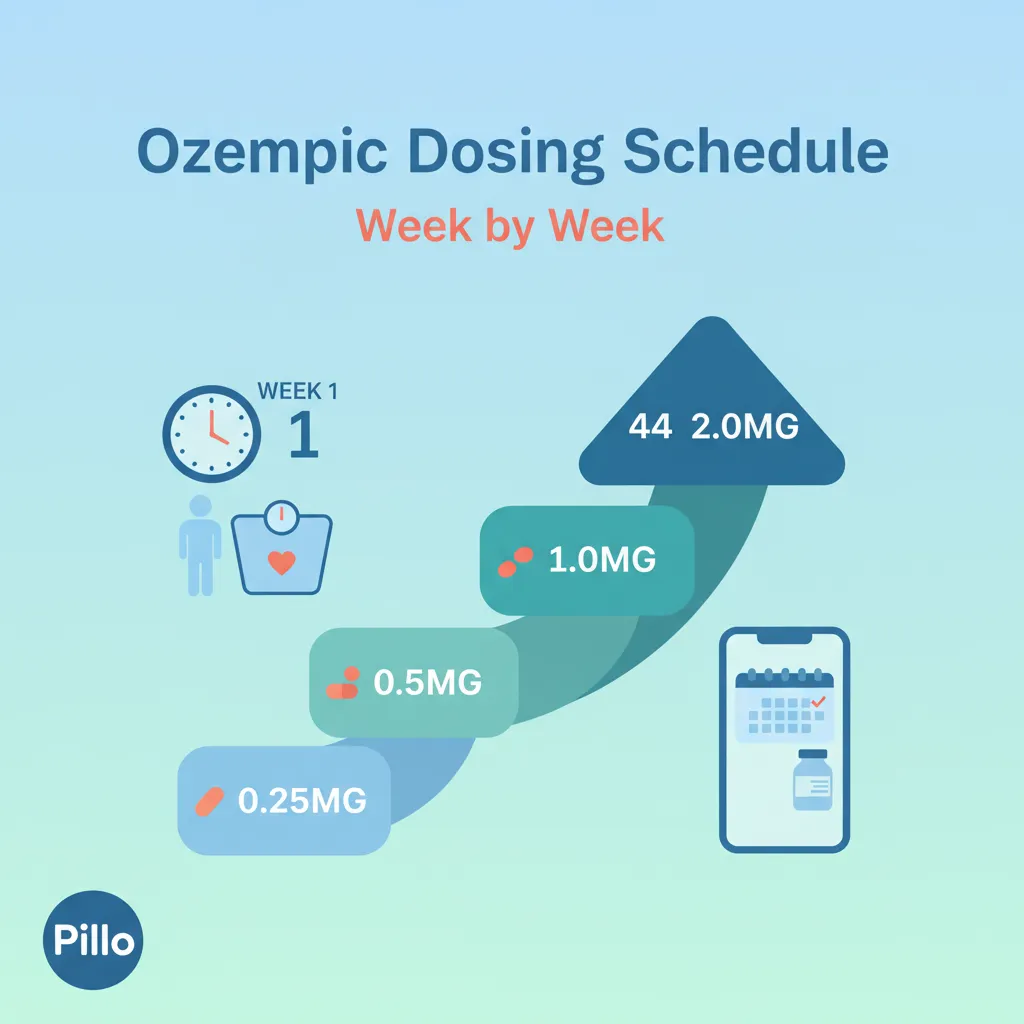
Ozempic (semaglutide) starts at 0.25 mg once a week for the first 4 weeks, then your doctor increases it to 0.5 mg. The maintenance dose is 1 mg weekly, and some patients go up to 2 mg. Each level lasts at least 4 weeks before the next increase. Rushing the schedule leads to worse side effects and doesn't speed up results.
This slow ramp-up exists for a reason. Semaglutide is a GLP-1 receptor agonist, and your body needs time to adjust to it. The dose escalation is what separates people who stick with the medication from those who quit after a few miserable weeks of nausea.
Here is the reality check that most dosing guides skip: only about 27% of GLP-1 users are still taking their medication at the one-year mark. The biggest drops happen in the first few months, often because side effects hit hard when the dose goes up too fast, or because people get frustrated when early weight loss is slower than expected.
The standard Ozempic dose escalation timeline
Your doctor sets the schedule, but the standard Ozempic escalation from the manufacturer follows this pattern:
| Phase | Dose | Duration | Purpose |
|---|---|---|---|
| Phase 1 | 0.25 mg weekly | Weeks 1 to 4 | Let your body adjust |
| Phase 2 | 0.5 mg weekly | Weeks 5 to 8 | First therapeutic dose |
| Phase 3 | 1 mg weekly | Week 9 onward | Standard maintenance dose |
| Phase 4 (optional) | 2 mg weekly | If needed | Maximum dose for additional effect |
Each phase lasts a minimum of 4 weeks. Your doctor may keep you at a dose longer if you're responding well or if side effects need more time to settle. There is no benefit to moving up faster than this schedule allows.
Important: Your doctor decides when and whether to increase your dose. Some patients stay at 0.5 mg or 1 mg indefinitely if they're seeing good results. The 2 mg dose is not automatic.
Weeks 1 to 4: the 0.25 mg starter dose
This is your adjustment period. The 0.25 mg dose is not a therapeutic dose for most people. It exists to get your gut and brain used to semaglutide before the real work begins.
What to expect:
- Mild appetite reduction. Some people notice it right away. Others feel almost nothing at 0.25 mg.
- Possible nausea, especially in the first 48 hours after each injection. It usually fades within a day or two.
- Minor GI effects like bloating, constipation, or loose stools.
- Weight loss of 0 to 3 pounds over the full 4 weeks. Some people lose nothing at this stage, and that is completely normal.
What not to expect: dramatic changes. This phase is about tolerance, not transformation. If you feel like nothing is happening, that's fine. The medication is building up in your system (semaglutide has a half-life of about 7 days, so steady state takes roughly 4 to 5 weeks).
Common mistake: getting discouraged by week 3 because the scale hasn't moved. The 0.25 mg dose is doing its job even if you can't see it yet.
Pick a consistent day of the week for your injection and stick with it. Since Ozempic is a once-weekly medication, it's surprisingly easy to forget which day you're supposed to inject. A weekly alarm that actually demands your attention makes a difference. Pillo's persistent weekly reminder won't stop alerting you until you confirm you've taken your dose, which matters when a single pen costs over $200.
Weeks 5 to 8: stepping up to 0.5 mg
This is the first dose where most patients start seeing meaningful results. Your doctor will increase you to 0.5 mg at the start of week 5 if you tolerated the starter dose well.
What to expect:
- Stronger appetite suppression. Meals feel more satisfying sooner.
- Nausea may return or increase when you first step up. It typically settles within 1 to 2 weeks.
- Weight loss of roughly 2 to 5 pounds over the 4-week period. Individual results vary widely.
- Food preferences may start shifting. Many people report losing interest in greasy or heavy foods.
Side effects to watch:
- Nausea is the most common. Eating smaller portions, avoiding fatty foods, and staying hydrated helps.
- Constipation affects roughly 5 to 10% of patients. Increasing fiber and water intake usually resolves it.
- Fatigue in the first week at the new dose. Your body is adjusting.
When to call your doctor: if nausea is severe enough that you can't keep fluids down, if you have persistent abdominal pain (especially radiating to your back, which could indicate pancreatitis), or if you notice any signs of an allergic reaction.
Many patients who do well at 0.5 mg stay at this dose. Moving to 1 mg is not mandatory if you're hitting your health goals.
Week 9 onward: the 1 mg maintenance dose
For most patients, 1 mg weekly is where the medication reaches its full effect. This is the standard maintenance dose that clinical trials used as the primary endpoint.
What to expect:
- The most significant appetite changes and weight loss tend to occur in the first 3 to 6 months at this dose.
- Side effects from the increase are usually milder than the jump from 0.25 to 0.5 mg, because your body already has weeks of adjustment behind it.
- Average weight loss in clinical trials (SUSTAIN studies) was about 12 to 14% of body weight over 68 weeks at the 1 mg dose, though results ranged widely.
Plateau concern: some patients hit a weight loss plateau after several months at 1 mg. This is normal. Your body is recalibrating. Talk to your doctor before assuming you need a higher dose. Lifestyle factors, like diet quality, activity level, and sleep, all influence how well the medication works.
The optional 2 mg dose
Novo Nordisk added the 2 mg dose option for patients who need additional glycemic control or weight management beyond what 1 mg provides. Not everyone needs it.
Your doctor may consider 2 mg if:
- Your blood sugar targets aren't met at 1 mg
- Weight loss has stalled and you have significant weight to lose
- You've been on 1 mg for at least 4 weeks with no tolerability issues
What to expect: side effects can increase again with this jump. The GI effects (nausea, diarrhea, constipation) are dose-dependent, meaning they tend to be more common at higher doses. The tradeoff is potentially better blood sugar control and additional weight loss.
Why you should not rush the escalation
It's tempting to ask your doctor to move up faster, especially if you're not seeing results at lower doses. Here is why patience matters:
- GI side effects are dose-dependent. The slow ramp lets your digestive system adjust gradually. Jumping from 0.25 mg straight to 1 mg dramatically increases the risk of severe nausea, vomiting, and diarrhea.
- Steady state takes time. With a 7-day half-life, semaglutide needs about 4 to 5 weeks to reach stable blood levels at any given dose. Increasing before steady state means you're stacking a new dose on top of an incomplete adjustment.
- Side effects are the top reason people quit. And quitting an $800 to $1,300 per month medication because you rushed the timeline is an expensive mistake.
Tracking your dose escalation
Keeping a simple log of your dose level, injection day, injection site, and any side effects gives you and your doctor useful data at each check-in.
You'll also want to track your injection site rotation to avoid repeated injections in the same spot, which can affect how well the medication absorbs.
Pillo's stock management feature lets you track how many pens you have left and alerts you before you run out. For a medication this expensive, running out before your refill is a problem worth preventing.
A note on Mounjaro and other GLP-1 medications
Mounjaro (tirzepatide) follows a similar concept of gradual dose escalation, but with different dose levels and its own timeline. If you're on Mounjaro instead, the same principle applies: slow and steady wins. And if you're curious about what happens when you miss a dose of Mounjaro, the rules are slightly different from Ozempic because of the different half-lives.
If you've already missed an Ozempic dose, check our guide on what to do when you miss a dose of Ozempic for the specific timing rules.
Frequently asked questions
How long does each Ozempic dose level last?
Each dose level lasts a minimum of 4 weeks. Your doctor may keep you at a particular dose longer if it's working well or if side effects need more time to resolve. There's no maximum duration at any dose level.
What if I have bad side effects when my dose increases?
Talk to your doctor. They may extend your current dose phase for another 4 weeks before trying the increase again, or they may decide the current dose is your maintenance dose. Tolerability matters more than reaching the highest possible dose.
Can I go back down to a lower dose?
Yes. If side effects at a higher dose are too much, your doctor can move you back to the previous level. This is a common and reasonable approach. The goal is the dose that gives you the best balance of benefits and tolerability.
Does Ozempic work better at higher doses?
Higher doses generally provide more blood sugar reduction and weight loss, but the relationship isn't linear. Some patients get excellent results at 0.5 mg. Others need 2 mg. Your response depends on your individual biology, diet, activity level, and other medications.
What happens if I miss a week during dose escalation?
If you miss one dose, take it as soon as you remember, as long as your next scheduled dose is at least 2 days away. If it's less than 2 days until your next dose, skip the missed one and resume your regular schedule. Missing a dose during escalation doesn't mean you need to restart from the beginning, but consistent weekly dosing keeps the medication working as intended. A persistent reminder like Pillo helps you stay on track when weekly medications are easy to forget.
Is the 2 mg dose always necessary?
No. Many patients achieve their goals at 0.5 mg or 1 mg. The 2 mg dose is an option, not a requirement. Your doctor will assess whether stepping up makes sense based on your blood sugar levels, weight loss progress, and side effect profile.
Related guides:
- Missed a dose of Ozempic? Here's what to do
- Mounjaro missed dose: the 4-day rule explained
- Starting Ozempic: what to expect your first week
- Ozempic injection site rotation: a simple system
- Running out of medication before your refill
- Best time to take metformin
- How to build a medication routine
- Can't remember if I took my medication
Medical Disclaimer: This article is for informational purposes only and is not a substitute for professional medical advice, diagnosis, or treatment. Always consult your doctor or pharmacist for advice specific to your medications.
Reviewed sources: Ozempic dosing information (Novo Nordisk), Ozempic FDA prescribing information, SUSTAIN clinical trial program
Reviewed under our Medical Review Policy.